






ESG, which stands for environmental, social, and governance, refers to a framework used to evaluate how companies manage sustainability risks, social impact, and corporate governance alongside financial performance.
For much of the past decade, ESG has become one of the most influential ideas in finance. It reshaped how companies were evaluated and how capital was allocated. What was once considered a secondary concern gradually moved to the center of investment decisions.
At its peak, ESG carried both moral and financial promises. Companies adopted sustainability targets; investors launched ESG-focused funds, and regulators began building new disclosure frameworks. The concept suggested that doing the right thing and achieving strong financial performance could align.
Recently, however, confidence has started to weaken. ESG is now facing criticism, political resistance, and growing skepticism within parts of the investment community. The discussion has shifted from enthusiasm to scrutiny.
The more relevant question today is not whether ESG is disappearing, but whether it is becoming more precise.
From Broad Concept to Practical Application
ESG was built on a simple idea. Companies do not operate in isolation, and their long-term success depends on how they manage environmental constraints, social dynamics, and internal governance.
In practice, however, the framework became too broad. By combining multiple dimensions into a single label, ESG often blurred the line between what is ethically desirable and what is financially material. Investors were sometimes left with scores and ratings that lacked consistency and clarity.
This created a structural problem. The same company could receive very different ESG ratings depending on the methodology used. As a result, confidence in the framework began to weaken, not because the underlying issues were irrelevant, but because the measurement was inconsistent.
The Backlash and Its Causes
Criticism of ESG has emerged from multiple directions.
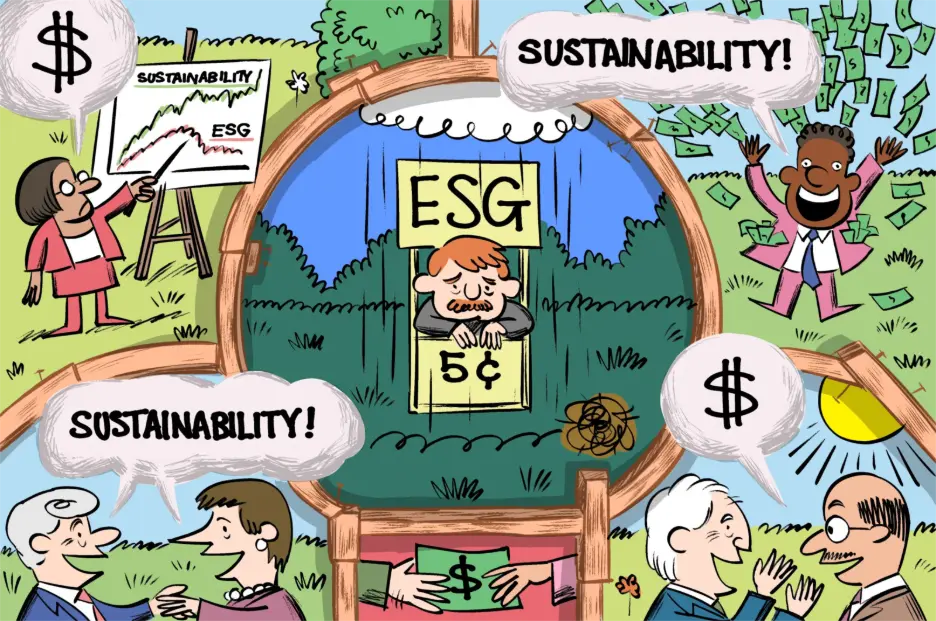
Some investors argue that ESG overreached by trying to incorporate too many objectives into one framework. Others point to greenwashing, where companies promote sustainability narratives without making meaningful operational changes.
At the same time, ESG has become politically contested, particularly in the United States, where it is sometimes viewed either as excessive corporate activism or as an ineffective tool for real change.
Source: Bloomberg News
What these criticisms have in common is not a rejection of environmental or social concerns, but a rejection of how ESG has been applied.
A Shift Toward Measurable Factors
What is happening now is a transition away from broad labels toward measurable inputs.
Investors are placing greater emphasis on data that can be directly linked to financial performance. Instead of relying on general ESG scores, analysis is becoming more granular. Carbon emissions, supply chain resilience, labor productivity, and governance structures are being examined individually rather than grouped under a single framework.
This shift reflects a broader principle in finance. Concepts that cannot be measured reliably tend to lose influence over time. As ESG moves toward quantifiable metrics, it becomes more useful and less dependent on interpretation.
Climate as a Financial Variable
One of the most important developments within this transition is the reframing of environmental issues.
Climate change is increasingly treated not as a moral question, but as a financial one. Physical risks such as extreme weather events can disrupt operations. Regulatory changes, including carbon pricing, can affect cost structures. Supply chains can be reshaped by environmental constraints.
As a result, climate analysis is being integrated directly into financial models. It is no longer separate from traditional valuation. It is becoming part of it.
This shift makes the concept more practical and less ideological, which is exactly what financial markets tend to demand.
Regulation and Standardization
While public debate around ESG has intensified, regulation continues to expand, particularly in Europe.
Disclosure requirements are becoming more detailed and more standardized. Companies are expected to report emissions, sustainability risks, and governance practices in a more structured way. This reduces ambiguity and makes comparisons easier.
Rather than disappearing, ESG is becoming embedded within formal reporting systems. The language may evolve, but the underlying requirements are becoming more concrete.
A More Selective Investment Approach
Investor behavior is also changing.
In the early stages of ESG investing, broad screening strategies were common. Entire industries were excluded, and companies were often evaluated based on general ESG ratings.
Today, the approach is more selective. Investors are increasingly focused on identifying which factors actually affect cash flows and long-term performance. The emphasis has shifted from branding to analysis.
This represents a more mature stage of development. Instead of asking whether a company fits within an ESG framework, investors are asking how specific risks and practices influence value.
The Evolution of ESG
What we are observing is not a decline, but a refinement.
The original ESG concept brought attention to issues that were previously underrepresented in financial analysis. That role remains important. However, the framework itself is being broken down into components that can be measured, compared, and integrated into standard financial models.
Environmental factors are becoming part of risk management. Social factors are increasingly linked to productivity and workforce stability. Governance remains a central determinant of corporate performance.
The label may become less prominent, but the substance is becoming more deeply embedded.
The Bigger Picture
Financial markets are ultimately driven by risk, return, and long-term value creation. As environmental and social factors increasingly influence these outcomes, they will continue to shape investment decisions regardless of how they are labeled.
The current debate around ESG reflects a transition from narrative to precision.
Not from relevance to irrelevance, but from broad concept to practical application.
And in finance, concepts that become measurable rarely disappear.

