





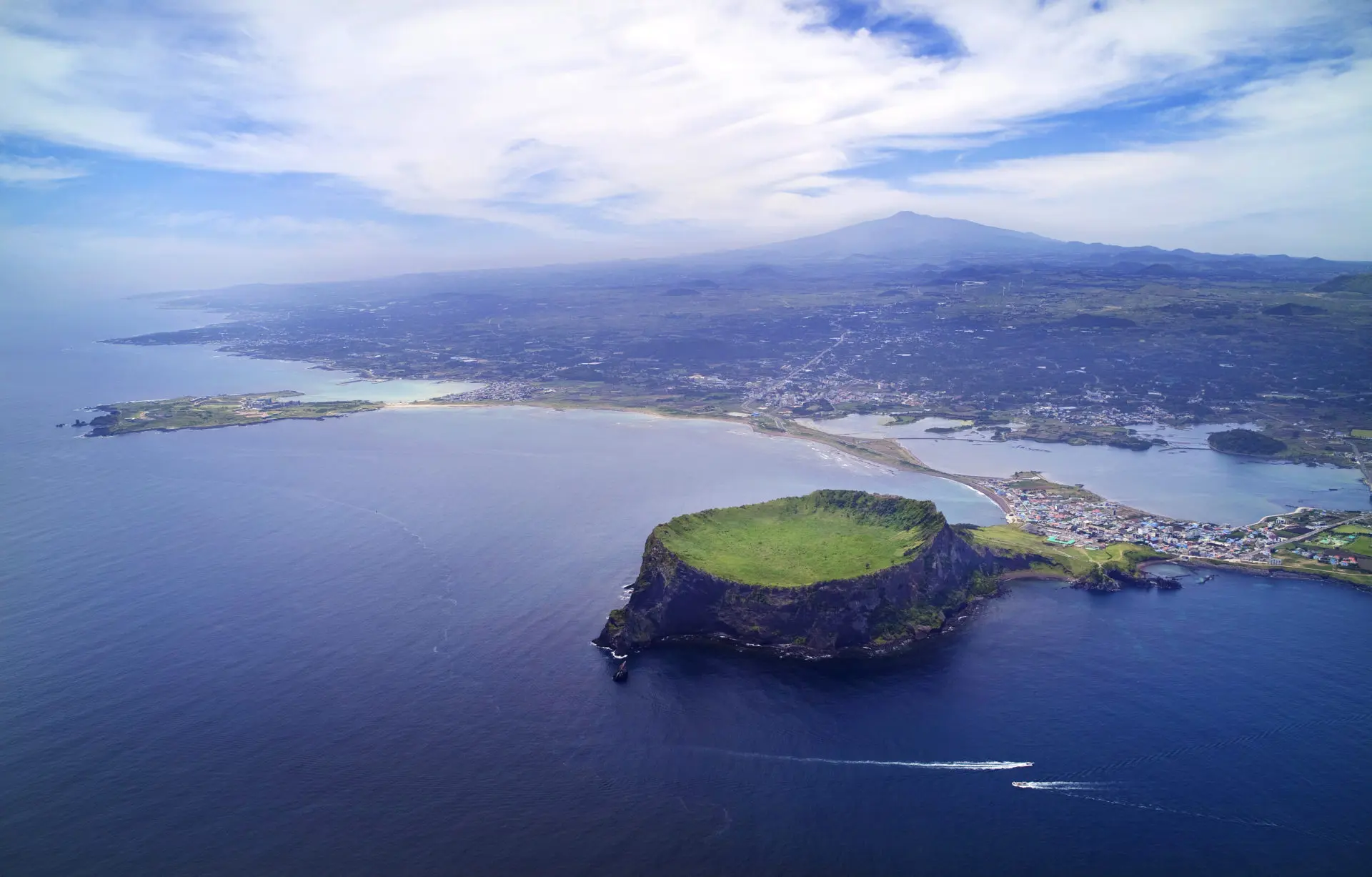
Most visitors associate South Korea with Seoul, technology, and dense urban life. Yet some of the country’s most distinctive landscapes are far from the capital, on Jeju Island, a volcanic island shaped by lava flows, coastal cliffs, and mountain terrain.
Often referred to as the “Hawaii of South Korea,” Jeju has become one of the country’s most important domestic travel destinations. The flight route between Seoul and Jeju is frequently cited as one of the busiest air routes in the world due to the constant movement of tourists and residents between the mainland and the island.
A Landscape Built by Volcanoes
Jeju’s terrain was formed through volcanic activity over hundreds of thousands of years. The island is dominated by Hallasan, the tallest mountain in South Korea, rising to about 1,950 meters, or roughly 6,400 feet.
Hallasan sits at the center of the island and is surrounded by hiking routes that pass through forests, volcanic rock formations, and changing climate zones. The summit crater is one of the island’s defining geological features.
Volcanic activity also created Jeju’s extensive lava tube systems. Among them is Manjanggul Lava Tube, one of the longest lava tubes in the world. The cave stretches for several kilometers and contains large lava formations created as molten rock cooled beneath the surface.
The Haenyeo Tradition
One of Jeju’s most distinctive cultural traditions is connected directly to the sea.
The Haenyeo are female free divers who harvest seafood without oxygen tanks, often diving to depths of around 20 meters on a single breath. Their work includes collecting abalone, sea urchins, and shellfish along Jeju’s coastline.
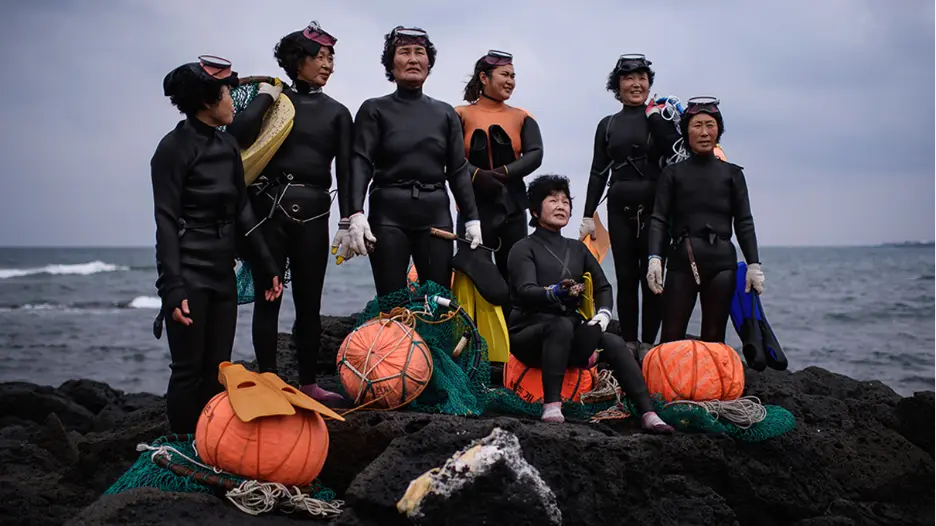
The tradition developed over centuries and became economically important for many coastal communities. Today, it is also recognized as part of UNESCO’s Intangible Cultural Heritage.
Seafood collected by haenyeo divers remains central to Jeju’s food culture and can be found in markets such as Dongmun Market.
Preserving Traditional Island Life
Beyond its natural landscapes, Jeju also preserves parts of traditional rural Korean culture.
Places such as Seongeup Folk Village maintain historical homes, local architecture, and older agricultural practices that developed in response to the island’s volcanic terrain and strong coastal winds.
These villages provide insight into how communities adapted to an environment shaped by limited farmland, isolation, and frequent exposure to natural forces.
Udo Island and the Coastal Landscape
Off Jeju’s eastern coast lies Udo, a smaller island known for its coastal scenery and volcanic geography.
Udo is particularly recognized for its dark volcanic sand beaches and rocky shoreline. Compared to central Jeju, the island is quieter and more focused on outdoor activities such as cycling, kayaking, and coastal hiking.
The surrounding waters also provide views of Seongsan Ilchulbong, a volcanic crater rising directly from the sea. Formed by an underwater eruption thousands of years ago, it is now one of Jeju’s most recognizable natural landmarks and part of UNESCO’s World Heritage listing on the island.
The Jeju Olle Trail
For travelers focused on nature rather than cities, the Jeju Olle Trail is one of the island’s defining experiences.
The trail system stretches for more than 400 kilometers, or around 250 miles, following Jeju’s coastline, forests, villages, and volcanic terrain. Rather than functioning as a single route, it is divided into sections that vary in difficulty and scenery.
The paths were designed to reconnect visitors with slower travel and direct interaction with the landscape.
More Than a Beach Destination
Although Jeju is often marketed as a resort destination, its identity is more closely tied to geology and environment than luxury tourism.
Volcanic landscapes, coastal ecosystems, and long-preserved local traditions shape the island more strongly than large urban development. Much of the experience comes from moving through these environments rather than simply observing them.
For many visitors, Jeju offers a different perspective on South Korea, one defined less by urban intensity and more by terrain, climate, and the relationship between communities and nature.
