





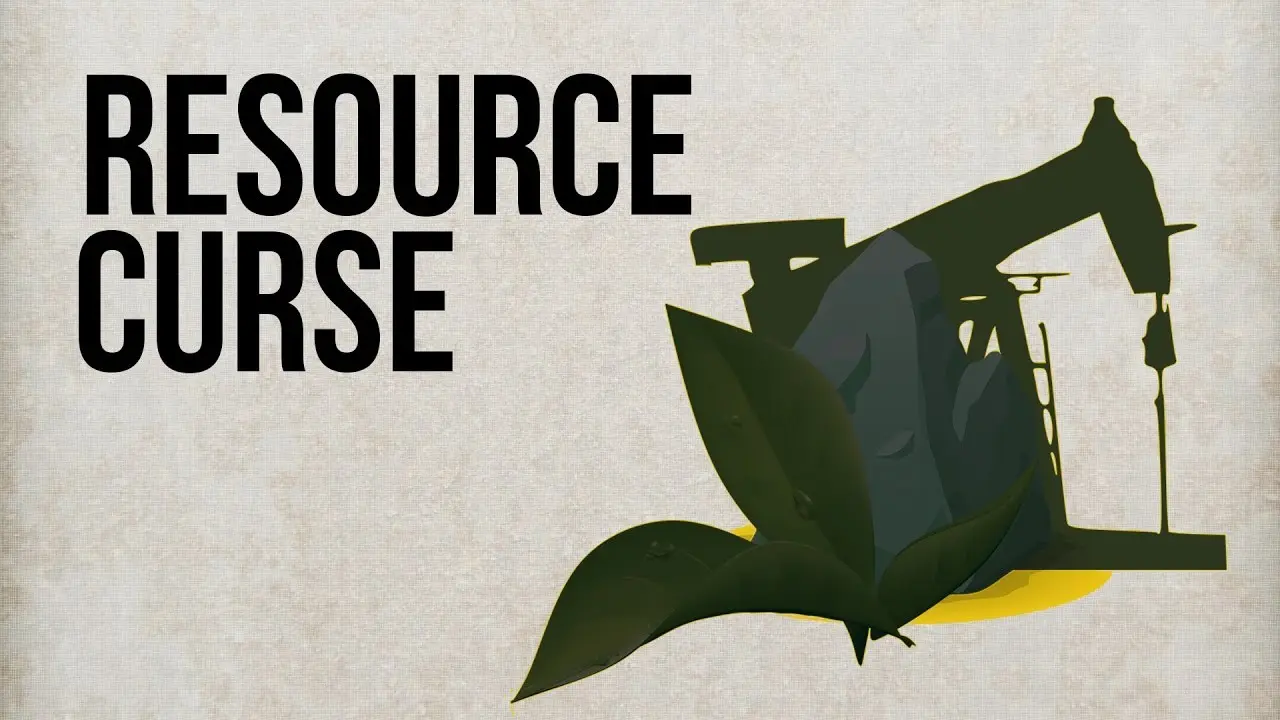
Natural resources are often associated with prosperity. Countries endowed with oil, gas, or minerals possess valuable assets that can generate revenue, finance public services, and accelerate development. Yet, a large body of research shows that many resource-rich countries experience weaker economic performance and poorer governance outcomes than countries with fewer natural resources. This paradox is known as the resource curse, a term describing the tendency of resource abundance to coincide with slower growth, institutional weakness, and political instability (Humphreys, Sachs, & Stiglitz, 2007).
The Nature of Resource Wealth
At its core, the resource curse reflects the unique nature of natural resource wealth. Unlike income generated through manufacturing or services, resource revenues do not depend on broad-based economic participation. Extraction can take place with limited involvement from the domestic labor force and with few linkages to other sectors of the economy. As a result, resource wealth often remains concentrated in a narrow segment of the economy, limiting spillovers that would otherwise support sustained development (Humphreys et al., 2007).
Rent-Seeking and Corruption
One of the central mechanisms behind the resource curse is the emergence of rent-seeking behavior. Natural resources generate significant economic rents, meaning that their market value exceeds the cost of extraction. This creates strong incentives for political and economic actors to compete for control over these revenues rather than invest in productive activities. In such environments, wealth accumulation becomes tied to access to resource revenues rather than innovation or efficiency, increasing the likelihood of corruption and misallocation of resources (Humphreys et al., 2007).
Weak Accountability and Political Systems
The structure of government finance changes significantly in resource-rich economies. When states rely heavily on revenues from oil or minerals, they become less dependent on taxation. This weakens the relationship between governments and citizens, as public spending is no longer directly tied to taxpayer contributions. As a result, accountability mechanisms tend to erode, and governments may become less responsive to public demands. Empirical evidence shows that such dynamics are associated with more authoritarian political systems and weaker institutional development (NRGI, 2015).
Economic Distortions and Dutch Disease
Economic distortions further reinforce these challenges. A common phenomenon in resource-rich economies is Dutch disease, where large inflows of foreign currency from resource exports lead to an appreciation of the domestic currency. This makes other export sectors, such as manufacturing and agriculture, less competitive internationally. At the same time, labor and capital shift toward the resource sector, reducing the capacity of other industries to grow. Over time, this process limits diversification and increases dependence on a single source of revenue (Humphreys et al., 2007; NRGI, 2015).
Revenue Volatility and Fiscal Instability
Another important dimension of the resource curse is revenue volatility. Commodity prices are inherently unstable, and fluctuations in global markets translate directly into government revenues. This creates cycles of expansion and contraction, where periods of high income are followed by sharp declines. Governments often increase spending during booms but struggle to adjust when revenues fall, leading to fiscal instability and, in some cases, debt crises. These boom–bust dynamics complicate long-term planning and undermine economic resilience (Humphreys et al., 2007; NRGI, 2015).
Underinvestment in Long-Term Development
The long-term development consequences are further shaped by investment decisions. Because resource wealth does not rely on human capital to the same extent as other sectors, governments may underinvest in education and skills development. This weakens the foundation for future growth, particularly once resource revenues decline. Without a diversified and skilled economy, countries may find it difficult to transition away from resource dependence (Humphreys et al., 2007).
Conflict and Political Instability
Political instability is another recurring feature of resource-rich economies. Control over valuable resources can intensify competition among groups, increasing the risk of conflict. In some cases, resource revenues are used to finance armed groups or sustain political power, further entrenching instability. Evidence suggests that countries with significant oil production are more likely to experience internal conflict compared to those without such resources (NRGI, 2015).
Can the Resource Curse Be Avoided?
Despite these patterns, the resource curse is not inevitable. There are clear examples of countries that have managed natural resource wealth effectively. The key difference lies in institutional quality and policy choices. Transparent governance, prudent fiscal management, and strategic investment in long-term development can mitigate many of the risks associated with resource dependence. In particular, mechanisms that strengthen accountability and promote economic diversification play a crucial role in transforming resource wealth into sustainable prosperity (NRGI, 2015).
Conclusion
The resource curse is best understood as a governance challenge rather than a purely economic phenomenon. Natural resources create opportunities, but they also introduce powerful incentives and distortions that can undermine development. Whether these resources become a blessing or a curse depends on how they are managed. Countries that recognize these risks and design policies accordingly are far more likely to convert natural wealth into lasting economic and social progress.
References (APA Style)
Humphreys, M., Sachs, J. D., & Stiglitz, J. E. (2007). Introduction: What is the problem with natural resource wealth? In M. Humphreys, J. D. Sachs, & Stiglitz, J. E. (Eds.), Escaping the resource curse. Columbia University Press.
Natural Resource Governance Institute (NRGI). (2015). The resource curse: The political and economic challenges of natural resource wealth.

