





Food prices rarely move randomly. Behind every spike in the cost of wheat, corn, or rice lies a chain of events involving weather, supply, energy costs, and global trade.
In recent years, one factor has become increasingly difficult to ignore: climate change. Rising temperatures, shifting rainfall patterns, and more frequent extreme weather events are beginning to affect how and where food can be produced. The consequences extend beyond agriculture itself. They influence commodity markets, trade flows, and ultimately food security.
Understanding this connection is essential for interpreting the future of global food prices.
Agriculture Is Exceptionally Climate Sensitive
Agriculture is one of the most climate-dependent sectors of the global economy. Crop yields rely on stable temperature ranges, predictable rainfall, and seasonal timing. Even small disruptions can significantly affect production.
Research in the field of Agricultural Economics consistently shows that higher temperatures reduce yields for several staple crops once certain thresholds are exceeded. Crops such as wheat, corn, and rice are particularly sensitive to heat during critical growth phases.
When temperatures rise beyond optimal levels, plants experience physiological stress. Photosynthesis slows, water demand increases, and the risk of crop failure rises. In many regions, rainfall variability further amplifies the problem, creating cycles of drought followed by intense flooding.
These disruptions reduce output and increase uncertainty for farmers and commodity markets.
Weather Shocks Translate into Price Volatility
Agricultural markets are highly responsive to supply changes. Because food demand is relatively stable in the short run, even modest declines in harvests can trigger sharp price increases.
Historical examples illustrate this mechanism clearly.
During the severe drought in the United States in 2012, corn yields fell dramatically. As a result, global corn prices surged, affecting food costs and livestock feed markets worldwide.
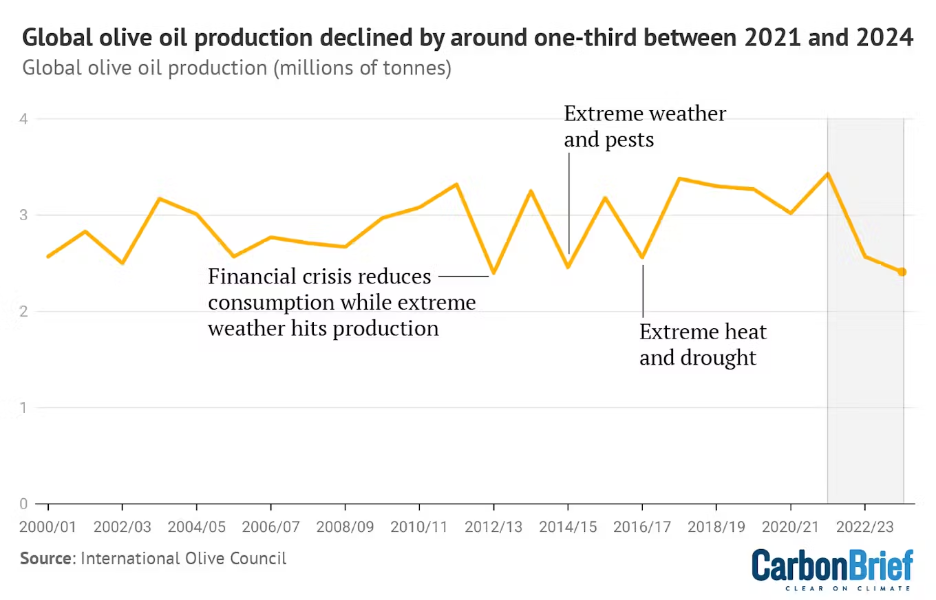
Similarly, heat waves in major wheat producing regions have repeatedly pushed international prices upward. Since many countries depend on imports for staple foods, production shocks in one region quickly propagate through global markets.
Climate change does not only threaten long-term productivity. It increases the frequency of these supply shocks.
Global Trade Spreads the Impact
Modern food systems are deeply interconnected. A disruption in one region rarely stays local.
For example, reduced wheat output in one exporting country can affect bread prices thousands of kilometers away. Countries in North Africa and the Middle East rely heavily on imported wheat, making them especially sensitive to price changes in global markets.
Commodity exchanges, storage levels, and government policies further influence how quickly price movements occur. When governments impose export restrictions during food shortages, global prices often rise even faster.
In this way, climate-related production shocks can become global economic events.
Food Security and Vulnerable Regions
The consequences of climate-driven price volatility are not evenly distributed.
Wealthy countries can absorb higher food prices relatively easily. In lower-income regions, food often represents a much larger share of household spending. Even modest increases in staple prices can push millions of people toward food insecurity.
Organizations such as the Food and Agriculture Organization and the World Food Programme have repeatedly warned that climate stress may intensify existing vulnerabilities in regions already struggling with poverty, political instability, or limited agricultural infrastructure.
Sub Saharan Africa and parts of South Asia face particular risks because many farming systems remain highly dependent on rainfall rather than irrigation.
In these areas, climate variability directly affects both production and livelihoods.
Adaptation and Technological Response
Despite these challenges, agriculture has always adapted to changing conditions.
Advances in crop genetics, irrigation technology, and precision agriculture are helping farmers manage climate variability. Drought-resistant seed varieties, improved weather forecasting, and better soil management practices can partially offset environmental stress.
However, adaptation requires investment, infrastructure, and knowledge transfer. Regions with limited financial resources may struggle to implement these solutions at scale.
This uneven capacity for adaptation may widen global disparities in agricultural productivity.
A Market That Reflects Environmental Risk
Agricultural commodity markets increasingly incorporate climate risk into pricing. Traders and analysts monitor weather forecasts, satellite crop data, and climate models when assessing future supply.
In effect, climate variability has become an economic variable.
The relationship between climate and food prices is therefore likely to grow stronger in the coming decades. As extreme weather events become more frequent, agricultural markets may experience more frequent price swings.
For consumers, this translates into less predictable food costs. For policymakers, it raises difficult questions about trade policy, food reserves, and international cooperation.
The Broader Economic Implication
Food sits at the foundation of economic stability. When food prices rise rapidly, the effects ripple through inflation, household budgets, and political systems.
Climate change does not automatically guarantee permanent food shortages. But it introduces new uncertainty into the most basic sector of the global economy.
Agriculture has always depended on the weather. What is changing is the stability of the climate itself.
And as that stability erodes, the economic consequences will increasingly appear on something everyone notices: the price of food.

