





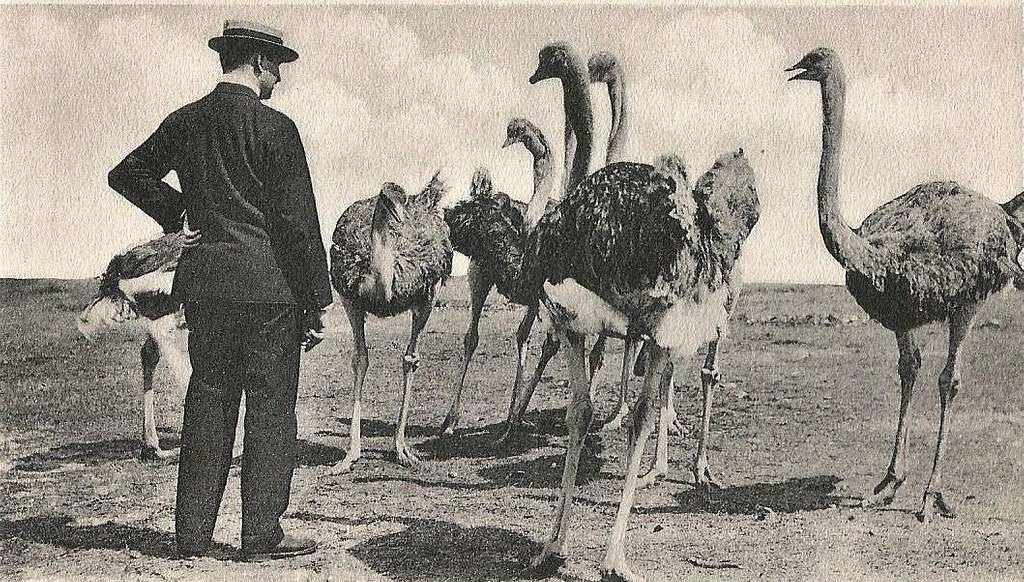
In 1932, the Australian government launched a military operation against an unlikely opponent. Not an invading army. Not an insurgency. Birds.
More specifically, Emu, a large flightless bird native to Australia, became the target of what later became known as the Emu War. The campaign lasted only a few weeks, but it produced one of the most unusual military stories of the twentieth century.
The surprising outcome was simple: the birds won.
Why Australia Declared War on Emus
The events unfolded in Western Australia, during the early years of the Great Depression.
After World War I, thousands of Australian veterans were given farmland in rural areas as part of a settlement program. Many began growing wheat, particularly in regions near the town of Campion.
The timing was unfortunate. In 1932, roughly 20,000 emus migrated to inland after their breeding season. The birds moved toward farming regions, searching for water and food.
Wheat fields became an easy target.
The emus trampled fences, destroyed crops, and opened pathways that allowed rabbits to invade farmland. For struggling farmers already dealing with falling wheat prices during the Depression, the damage was devastating.
Farmers requested government intervention.
The Military Gets Involved
Instead of relying on hunters or bounty programs, the government approved a military response.
The Australian Minister of Defence at the time, George Pearce, authorized the deployment of soldiers equipped with Lewis machine guns. The operation was led by Major G. P. W. Meredith of the Royal Australian Artillery.
The plan sounded straightforward. Soldiers would locate large groups of emus and eliminate them using military grade weapons.
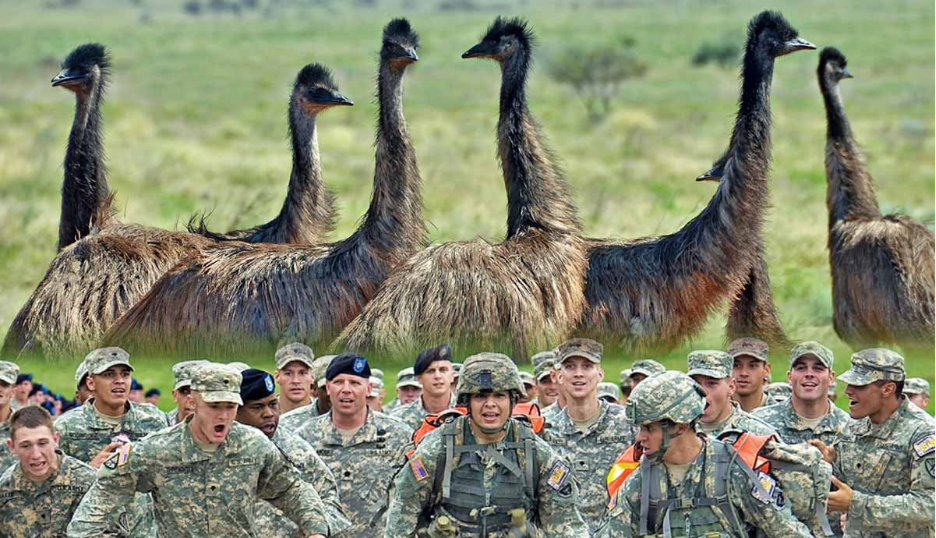
Source: TheCollector
In theory, the birds would be easy targets.
In practice, they were not.
Why the Birds Were Hard to Defeat
Emus turned out to be surprisingly resilient opponents.
First, they rarely traveled in tight groups. Large flocks often broke into smaller clusters when approached, making them difficult targets for machine gun fire.
Second, emus were extremely fast. They can run up to 50 kilometers per hour, easily outrunning soldiers on foot.
Third, their behavior complicated targeting. Observers reported that the birds appeared to organize themselves into small groups, with some acting as lookout while others fed.
When gunfire began, the birds scattered in multiple directions.
One famous attempt involved mounting a machine gun on a truck to chase emus across farmland. The terrain proved too rough, and the operation failed.
The Outcome
Over several days of attempts, thousands of rounds of ammunition were fired.
The number of birds actually eliminated was relatively small compared to the size of the migrating population.
At one point, Major Meredith reportedly remarked that if Australia had a military division with the mobility of emus, it would be unstoppable.
The operation became increasingly embarrassing.
Within weeks, the government withdrew the military forces.
The emus continued migrating across the farmland largely unaffected.
What Happened After the “War”
Despite the failed military effort, the problem did not disappear.
Eventually, authorities returned to more conventional methods:
- bounty systems for farmers
- improved fencing
- population management through civilian hunting
Over time, these measures proved more practical than deploying machine guns.
The episode itself quickly became a historical curiosity.
Why the Emu War Became Famous
The Emu War is often remembered as a humorous story, but it reflects a real tension between agriculture and wildlife management.
Australia’s environment has always posed unique challenges for farming. Native species adapted to vast landscapes do not easily conform to human land use.
The military campaign highlighted the limits of force when applied to ecological problems.
In the end, the lesson was simple.
Nature does not always respond to strategy, technology, or firepower.
Sometimes, it simply runs away faster.

