






In most industries, productivity improves over time. Technology allows workers to produce more output with the same or fewer resources. As a result, costs per unit tend to fall or grow slowly. Yet in sectors such as healthcare, education, and the arts, costs consistently rise faster than inflation. This pattern is explained by a concept known as Baumol’s Cost Disease, developed by economists William Baumol and William Bowen. The idea is not that these sectors are inefficient. It is that they operate under structural constraints that limit productivity growth. Baumol’s insight begins with a simple comparison. In manufacturing, productivity can increase significantly. A factory that once required 100 workers may now produce the same output with 20 due to automation and technology. In contrast, many service activities cannot be compressed in the same way. A teacher still needs time to teach a class. A doctor still needs time to examine a patient. A string quartet still requires four musicians to perform a piece written centuries ago. The output per worker in these sectors changes slowly, if at all.
Wages Still Rise & Why Prices Increase
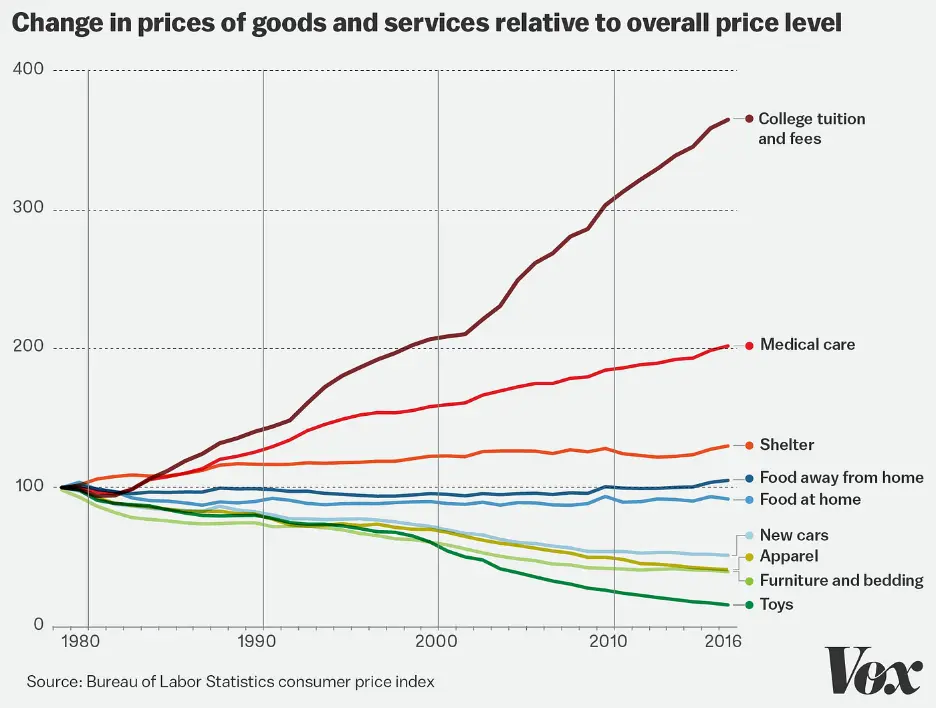
Even if productivity does not increase, wages in these sectors cannot remain stagnant. Workers compare their earnings to opportunities in other industries. If wages rise in more productive sectors such as technology or manufacturing, employers in healthcare or education must raise wages as well to retain staff. This creates a mismatch. Productivity remains relatively constant, but labor costs increase. Since labor is the primary input in these sectors, overall costs rise. As wages increase without corresponding productivity gains, the cost of providing services rises. Hospitals, schools, and cultural institutions must charge more simply to maintain operations. The increase is not driven by higher output or quality improvements, but by rising input costs. This explains why tuition fees, medical costs, and ticket prices for live performances tend to grow faster than general inflation.
Healthcare provides a clear example. Advances in medical technology improve treatment outcomes, but they often do not reduce the time required for care. A doctor still needs to interact with patients, and many procedures remain labor-intensive.
Source: Vox
Education shows a similar pattern. While digital tools have been introduced, the core structure of teaching has not changed dramatically. A lecturer still delivers content to a group of students, and reducing staff significantly can affect quality. In the arts, the constraint is even more visible. A live performance requires the same number of performers and roughly the same amount of time as it did in the past.
Misinterpretation of Inefficiency & Broader Economic Implications
Rising costs in these sectors are often interpreted as inefficiency. Baumol’s framework suggests otherwise. The issue is not poor management, but the nature of the work itself. Some activities are inherently resistant to productivity gains. When labor cannot be replaced or accelerated without reducing quality, cost increases become unavoidable. As economies develop, a larger share of spending shifts toward services. This means that sectors affected by Baumol’s cost disease occupy a growing portion of economic activity. As a result, overall inflation can be influenced by rising costs in these areas. Governments are particularly affected because healthcare and education represent significant parts of public spending. Budget pressure increases as costs rise faster than productivity. Technology can partially mitigate the effect, but it does not eliminate it. Digital tools can improve efficiency at the margins. For example, administrative tasks can be automated, and online platforms can expand access to education. However, the core services still require human input. A fully automated system often changes the nature of the service rather than improving its productivity in the traditional sense. Baumol’s cost disease explains a pattern that is visible across advanced economies. Costs rise in sectors where productivity growth is limited, even when there is no clear increase in output. Understanding this helps clarify why certain services become more expensive over time and why this trend is difficult to reverse. It is not simply a policy failure or market inefficiency. It is a structural feature of how different parts of the economy evolve.

