





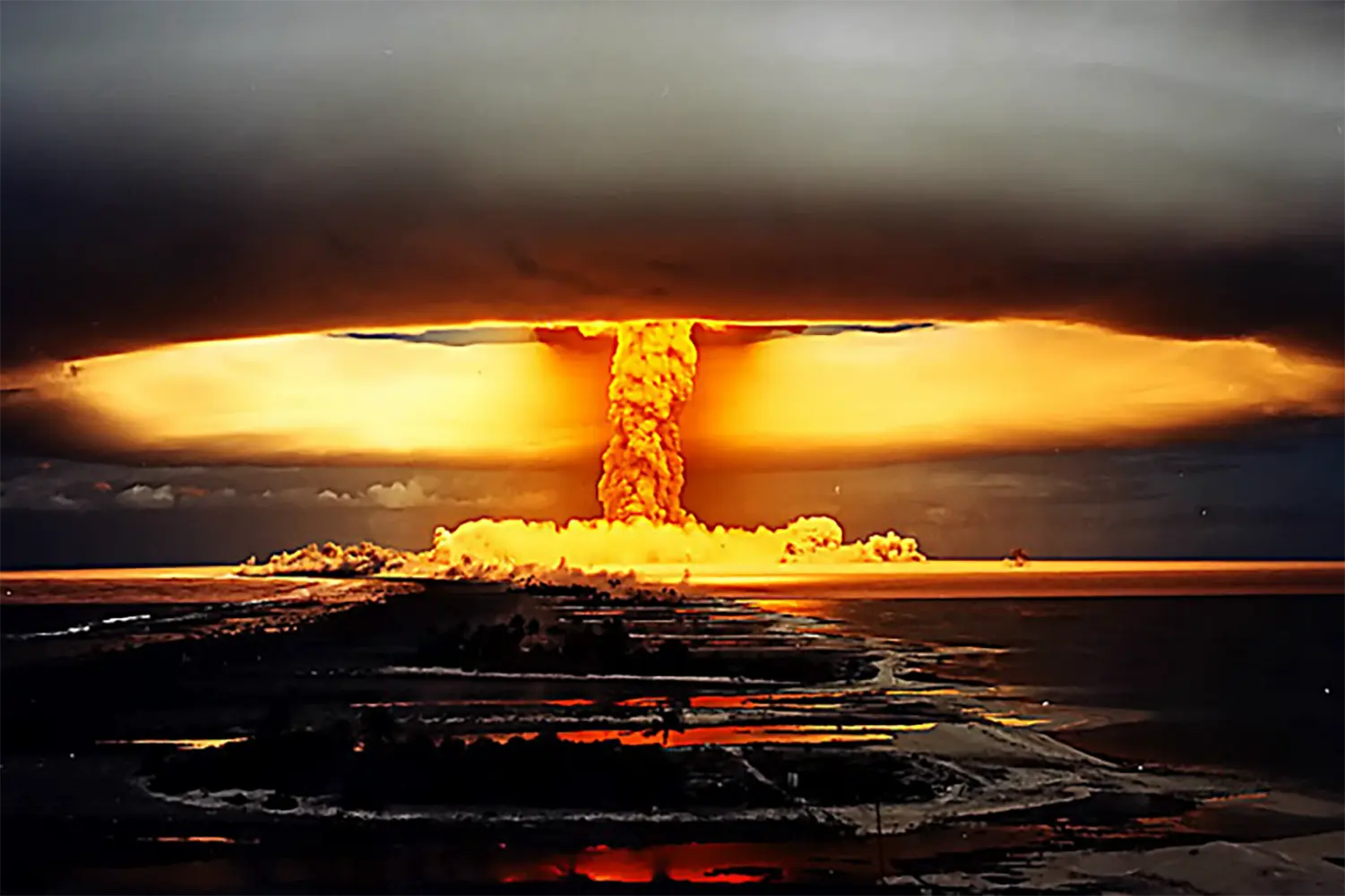
The history of nuclear proliferation is not simply the story of more countries acquiring more dangerous weapons. It is the story of how a scientific breakthrough created a permanent tension between civilian progress and military risk. Nuclear energy offered the possibility of large-scale electricity generation through fission, a process in which the nucleus of an atom splits and releases immense energy (IAEA, 2021). Yet from the beginning, the same scientific knowledge that enabled civilian nuclear development also opened the path to atomic weapons. That is why proliferation has always been difficult to control. It is rooted not only in military ambition, but in the dual-use character of nuclear technology itself.
This is what makes the history of proliferation analytically important. States did not pursue nuclear weapons randomly. They did so under specific conditions: fear of rivals, desire for prestige, distrust of allies, and access to civilian nuclear infrastructure. Charnysh (2006) shows that the spread of nuclear weapons followed a chain of reactions in which each state’s decision influenced the next one, creating what she calls a vicious circle of proliferation. The broader lesson is that nuclear weapons did not spread because states were irrational, but because the international system often made restraints feel risky.
The Scientific Basis of the Problem
Any history of proliferation has to begin with science, because the political problem cannot be understood without the technical one. Nuclear energy is produced today through fission, usually involving uranium 235. When struck by a neutron, the atom splits, releases heat and radiation, and emits more neutrons, creating a chain reaction. In civilian nuclear plants, this heat is used to produce steam, which then powers turbines and generates electricity (IAEA, 2021). On its own, this sounds like a story of industrial modernization. The problem is that the same nuclear fuel cycle involves uranium mining, enrichment, reactor operation, and spent fuel management, all of which create knowledge and infrastructure that may also be relevant for military purposes (IAEA, 2021).
The First Nuclear Power and the Start of the Chain
The United States became the first nuclear-weapon state in 1945. According to Charnysh (2006), the Manhattan Project was launched under the fear that Nazi Germany might acquire the bomb first, and it pursued several parallel technological routes in order to maximize the chance of success. By the time the first US test took place, Germany had already surrendered, but the bomb was still used against Japan at Hiroshima and Nagasaki. This moment did not establish long term nuclear monopoly. It established a new strategic reality.
What matters historically is that the first bomb did not end proliferation. It started it. Once the United States demonstrated that nuclear weapons were possible, other powers could no longer ignore the strategic implications. From that point onward, every major rival had to ask whether its own security could survive in a world where only another state possessed nuclear weapons. The bomb, therefore, transformed nuclear science into a permanent problem of international politics.
The Cold War and Strategic Proliferation
The Soviet Union’s first nuclear test in 1949 ended the brief American monopoly. Charnysh (2006) explains that the Soviet decision was deeply political, driven by the shock of Hiroshima, the desire to restore strategic balance, and the need for international prestige and security in the postwar world. Once the Soviet Union entered the nuclear age, the United States accelerated work on the hydrogen bomb, fearing that the Soviets would gain an even greater advantage if Washington hesitated. This is one of the clearest examples of proliferation as a reactive process. States were not simply pursuing bigger arsenals out of abstract ambition. They were responding to what other states had already done.
The same logic shaped later proliferation among the recognized nuclear powers. Britain pursued its own bomb after the United States cut off nuclear cooperation. France moved toward an independent deterrent partly because it no longer trusted American guarantees and wanted to recover national status after geopolitical humiliation. China, in turn, treated the bomb as a response to external vulnerability and strategic threat (Charnysh, 2006). What links these cases is that nuclear weapons were seen as instruments of autonomy. Possessing them meant not having to rely completely on another power for survival.
Atoms for Peace and the Contradiction of Civilian Expansion
One of the most important turning points in proliferation history came not through weapons testing, but through peaceful nuclear cooperation. In 1953, President Eisenhower launched the Atoms for Peace program, which aimed to spread civilian nuclear technology while discouraging military use. Yet Charnysh (2006) shows that this policy carried a deep contradiction. In trying to normalize peaceful nuclear development, the United States and the Soviet Union helped spread reactors, materials, and technical knowledge across a much wider group of states.
This matters because proliferation does not always advance through secret theft or illegal smuggling. Sometimes it advances through legal and peaceful cooperation. India is one of the clearest examples. The country participated extensively in civilian nuclear cooperation, trained scientists through foreign programs, and acquired technology that later contributed to its weapons path (Charnysh, 2006). The broader problem was structural. Once civilian nuclear infrastructure expands internationally, the gap between peaceful and military capacity narrows. The system may still be governed by safeguards, but the technological threshold is lower than before.
Davis (2022) makes this broader point from the perspective of the current energy transition. Nuclear energy remains attractive because it is a low-carbon source of electricity, has long plant lifetimes, and can support climate and energy security goals at the same time. Yet that same attractiveness means civilian nuclear programs continue to expand in new and old markets. The historical tension evolved into a more complicated modern setting in which states may pursue nuclear energy for climate, security, commercial, or prestige reasons, while still enlarging the global base of nuclear capability (Davis, 2022).
The Non Proliferation Treaty and the Shift to Management
By the 1960s, it had become obvious that the world needed a formal system to slow the spread of nuclear weapons. The Nuclear Non Proliferation Treaty, signed in 1968 and entering into force in 1970, represented that effort. Charnysh explains that the treaty recognized five official nuclear weapon states and attempted to prevent the transfer of weapons or assistance to non-nuclear weapon states, while still preserving the right to peaceful nuclear energy under safeguards.
This was a compromise rather than a solution. The treaty did not eliminate nuclear inequality. It institutionalized it. Some states were permitted to remain nuclear powers, while others were expected to stay non-nuclear. That arrangement helped slow proliferation, but it also generated criticism, especially from countries that saw it as discriminatory. Charnysh notes that India refused to join for precisely this reason (Charnysh, 2006). The treaty, therefore, reduced proliferation pressure without fully removing the political grievances behind it.
The IAEA became central in this managed system. As the agency explains, its safeguards and verification activities are designed to ensure that nuclear materials and technologies are not diverted from peaceful use (IAEA, 2021). But even this model has limits. Safeguards can raise the cost of cheating and increase transparency, yet they cannot remove the underlying fact that civilian infrastructure creates latent capability. The NPT, therefore, works best as a barrier, not as a guarantee.
India, Pakistan, and the Regionalization of Proliferation
The cases of India and Pakistan reveal how proliferation moved from superpower rivalry to regional deterrence. In India’s case, the 1964 Chinese test, conflict with Pakistan, and frustration with the unequal structure of the nuclear order all contributed to the eventual decision to test in 1974 and again in 1998 (Charnysh, 2006). India’s path demonstrates that proliferation can be driven by both security concerns and the politics of status. The bomb was seen not only as deterrence, but also as proof of sovereign equality in a world divided between nuclear insiders and outsiders.
Pakistan followed a more directly reactive path. After India’s 1974 test and earlier military defeats, Pakistani leaders concluded that conventional balance alone was insufficient. Charnysh (2006) notes the now famous willingness to “eat grass” if necessary in order to match India’s capability. This is a crucial historical pattern. Proliferation often happens not because a state wants global power, but because it believes nuclear inferiority would leave it permanently exposed in a regional rivalry.
These two cases also demonstrate why nonproliferation regimes struggle most when adversaries face each other directly. Global norms matter, but immediate security competition often matters more. Once one state in a rivalry crosses the threshold, the political pressure on the other rises sharply.
Israel, North Korea, and the Logic of Survival
Israel and North Korea represent two different versions of the same broader principle: when national survival is perceived to be at stake, nuclear restraint becomes much harder to sustain. Israel’s nuclear trajectory is rooted in existential insecurity and enabled through foreign cooperation, especially with France. Israel never openly confirmed its arsenal, but its strategy of ambiguity itself became part of regional politics. The purpose was not necessarily public display, but deterrence without formal declaration.
North Korea followed a more confrontational route. Its proliferation is linked to prestige, bargaining leverage, and regime survival, with repeated cycles of partial cooperation followed by renewed escalation (Charnysh, 2006). North Korea is particularly important because it shows that a state can enter the treaty system, participate in negotiations, and still move toward weaponization if leadership concludes that nuclear capability is essential for regime security. This is one reason why the history of proliferation cannot be reduced to institutional design alone. Political incentives remain decisive.
States That Reversed Course
One of the most useful parts of Charnysh’s analysis is her attention to states that abandoned nuclear ambitions. South Africa is the clearest example. It built a nuclear arsenal under conditions of isolation and insecurity, then dismantled it when the strategic environment changed and the political liabilities of nuclear weapons began to outweigh their benefits. This case is important because it proves that proliferation is not irreversible. States can change course when their security, economic, and diplomatic calculations change.
The same applies, in different ways, to Brazil, Argentina, Ukraine, Belarus, Kazakhstan, and Libya. Some of these states stepped back because of democratization, some because of regional accommodation, and some because outside powers offered compensation, guarantees, or integration into a wider political order (Charnysh, 2006). The analytical point is that nonproliferation works best when restraint aligns with national interest. It is weaker when restraint is treated merely as moral persuasion.
Conclusion
The history of nuclear proliferation shows that the spread of nuclear weapons has never been random. It has followed clear political and structural logics. First came the scientific breakthrough that made both civilian power and atomic destruction possible. Then came the strategic reactions of great powers that refused to remain vulnerable. After that came an international attempt to manage the spread through treaties and safeguards, without ever fully solving the contradiction between peaceful and military uses of nuclear technology.
References
Charnysh, V. (2006). A Brief History of Nuclear Proliferation.
Davis, A. J. (2022). The Role of Nuclear Energy in the Global Energy Transition. Oxford Institute for Energy Studies.
International Atomic Energy Agency. (2021). What Is Nuclear Energy? The Science of Nuclear Power.

