





Esports, or competitive video gaming, is often seen as a recent phenomenon. In reality, its roots go back several decades, long before streaming platforms and million-dollar tournaments.
What has changed is not the existence of competitive gaming, but its scale, structure, and commercial value.
Early Competitive Gaming
The first organized video game competitions appeared in the 1970s and 1980s. One of the earliest examples was a tournament held at Stanford University in 1972, where players competed in the game Spacewar!.
In the 1980s, arcade culture created informal competitive environments. Players competed for high scores on games like Pac-Man and Donkey Kong, often recorded on leaderboards inside arcades.
These competitions were localized and unstructured, but they introduced the core idea of gaming as a competitive activity rather than just entertainment.
The Internet and Organized Competition
The development of the internet in the 1990s transformed competitive gaming.
Multiplayer games such as Quake, StarCraft, and Counter-Strike allowed players to compete across long distances. This removed the need for physical proximity and expanded the pool of competitors.
At the same time, organized tournaments began to appear. Events such as the Cyberathlete Professional League and later the World Cyber Games introduced structured competition, prize pools, and early forms of professional play.
South Korea played a particularly important role during this period. Competitive StarCraft became a national phenomenon, with televised matches and professional players gaining celebrity status.
Professionalization and Streaming
The 2000s and early 2010s marked a shift from organized competition to full professionalization.
Teams, sponsors, and leagues began to form around major titles. Players started training full-time, often living in team houses and working with coaches.
The launch of platforms like Twitch changed how esports were consumed. Matches could now be watched live by global audiences, without the need for traditional broadcasting.
This created new revenue streams through advertising, subscriptions, and sponsorships. It also allowed individual players and teams to build their own audiences directly.
At the same time, certain games became dominant competitive platforms. Titles such as League of Legends, Dota 2, and Counter-Strike: Global Offensive established long-term ecosystems with regular tournaments and international championships.
The Modern Esports Industry
Today, esports operates as a global industry.
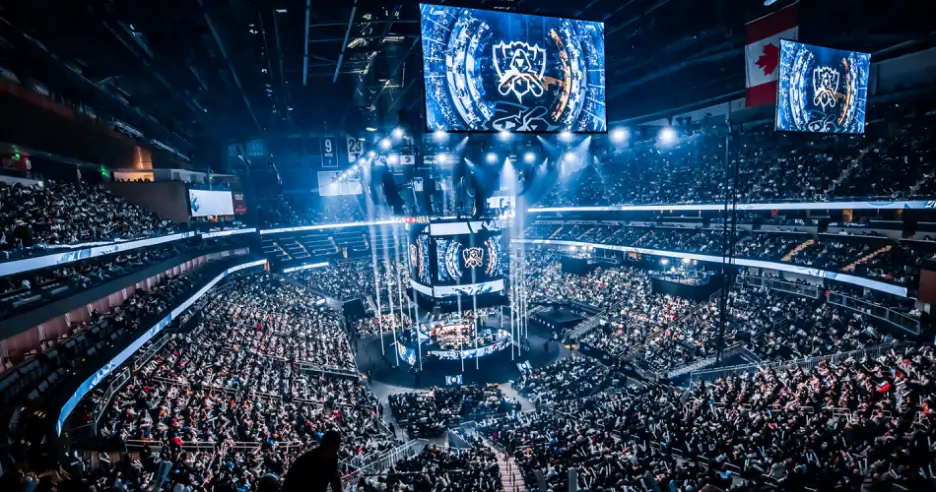
Major tournaments fill large stadiums, and prize pools can reach tens of millions of dollars. The International, a Dota 2 tournament, is known for having some of the largest prize pools in competitive gaming.
Professional teams function similarly to traditional sports organizations, with structured management, sponsorship deals, and brand partnerships.
Revenue in esports comes from multiple sources:
- sponsorship and advertising
- media rights
- merchandise
- in-game purchases linked to events
Game publishers play a central role. Unlike traditional sports, where no single entity owns the game itself, esports ecosystems are often controlled by the companies that develop the games.
How Esports Compares to Traditional Sports
Esports differs from traditional sports in several key ways.
First, it is entirely digital. This allows global participation without physical limitations, but also makes it dependent on game developers and technology infrastructure.
Second, the lifecycle of games is shorter. While sports like football remain stable for decades, esports titles can rise and decline within a few years depending on player interest and developer support.
Third, the audience is younger and more digitally engaged. Consumption happens primarily through streaming platforms rather than television.
Despite these differences, the underlying structure is similar. Competition, spectatorship, and professional organization follow patterns seen in traditional sports.
Where Esports Stands Today
Esports is no longer a niche activity. It has become a recognized segment of the global entertainment industry.
At the same time, the sector is still evolving. Some leagues struggle with profitability, and not all games sustain long-term competitive scenes. The industry depends heavily on continued player engagement and publisher investment.
Growth remains strong, but it is uneven. The most successful titles maintain stable ecosystems, while others fade quickly.
A Changing Definition of Sport
The rise of esports reflects a broader shift in how competition and entertainment are defined.
What began as small-scale gaming competitions has developed into a global industry with professional players, large audiences, and significant financial investment.
The core idea has remained consistent. Competition attracts attention. What has changed is the medium through which it happens.

