






In Northern Denmark, there is a community that operates differently from the rest of the economy.
In Thy Lejren, prices are largely absent. There are no wages, no internal buying or selling, and no conventional job titles. Instead of money, the system runs on contribution, trust, and shared responsibility.
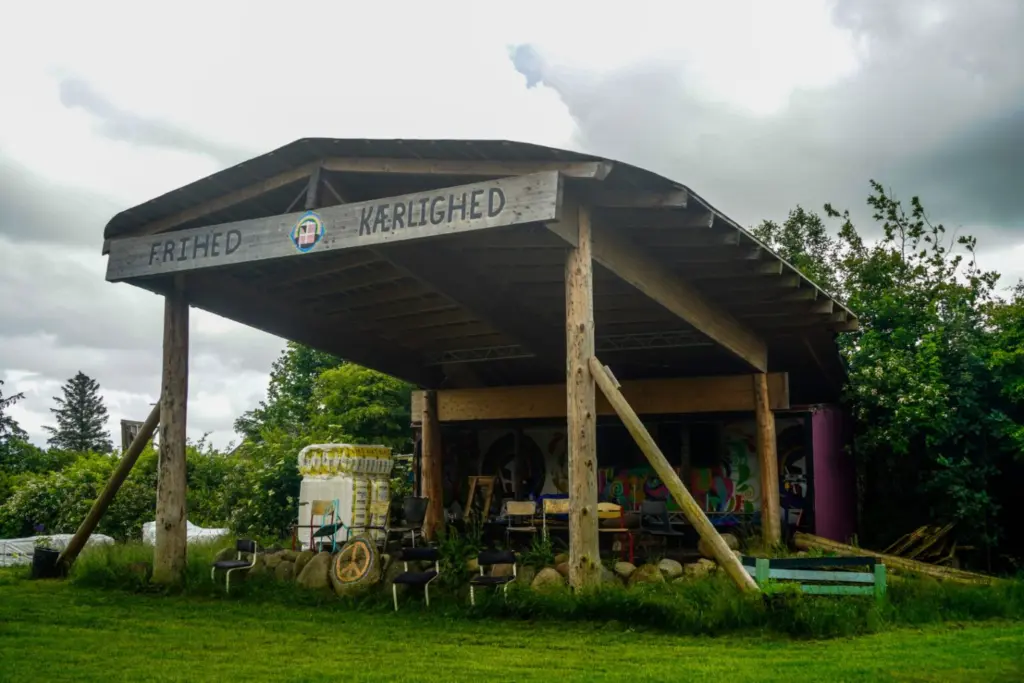
Founded in 1970, Thy Lejren emerged from Denmark’s alternative and communal movements. For more than five decades, it has functioned as a seasonal self-managed settlement where participants experiment with a different way of organizing daily life.
How the Community Operates
Inside Thy Lejren, economic activity does not follow traditional market rules.
There are:
- no supermarkets in the conventional sense
- no individual landlords renting property
- no fixed salaries
- no price tags attached to daily tasks
Instead, food is grown in shared gardens. Meals are prepared collectively. Homes and common spaces are built and maintained through voluntary labor.
If a roof needs repair, someone with carpentry skills steps in. If childcare is needed, families coordinate support. If a resident is ill, others cook meals or provide assistance without billing or formal exchange.
Responsibilities are chosen rather than assigned by hierarchy. Cooking, cleaning, construction, logistics, and maintenance rotate or are taken up by those willing to contribute.
The system relies on mutual obligations rather than contracts.
Not an Isolated Economy
It is important to understand that Thy Lejren does not exist entirely outside the national economy. Residents and participants still earn money in the broader Danish system. Materials, tools, and land rights interact with formal property law.
The difference lies in how internal life is organized. Within the settlement, transactions are minimized, and social capital replaces financial capital as the main coordinating mechanism.
Visitors are often told that they cannot “buy” anything inside the community. Instead, they are expected to contribute time, labor, or participation.
Time, Skills, and Trust
Rather than pricing services, Thy Lejren functions on reciprocal contribution.
If someone contributes by cooking for a week, they are not paid in money. They receive housing, food, and community in return. If another person builds infrastructure or manages logistics, they do so as part of shared responsibility rather than employment.
This model resembles what economists describe as a gift economy or commons-based organization, where value circulates through participation instead of market exchange.
Trust becomes a central mechanism. Without formal contracts or financial incentives, the system depends on social cohesion and reputation.
Crime and Social Structure
One of the striking features often mentioned by visitors is the low level of internal conflict related to theft or economic competition.
When personal accumulation is limited and resources are shared, there is little incentive to steal. Without formal hierarchies tied to income, status competition is reduced.
This does not mean the community is free of disagreements. Governance still requires meetings, consensus-building, and conflict resolution. But economic inequality plays a smaller role in social tension compared to conventional market societies.
Longevity of the Model
Thy Lejren has existed for more than fifty years, which distinguishes it from short-lived communal experiments.
Its survival suggests that non-monetary coordination can function at small scale under certain conditions:
- shared values
- voluntary participation
- relatively small population
- external economic support from the wider society
It does not aim to replace national markets, but to demonstrate an alternative internal structure.
How Economists View It
From an economic perspective, Thy Lejren challenges standard definitions of productivity and exchange.
Traditional economics measures output, income, and prices. In Thy Lejren, many essential activities are unpaid and unpriced. Yet housing is built, food is produced, and services are delivered.
Rather than eliminating value, the community shifts how value is recognized.
Some researchers classify such settlements as examples of:
- cooperative governance
- commons management
- social economy structures
The model works primarily because participation is voluntary. Those who do not wish to contribute can leave, and newcomers enter with awareness of the norms.
Belonging as Infrastructure
At its core, Thy Lejren illustrates that economic systems are built not only on currency, but also on relationships.
Money simplifies exchange between strangers. In small communities where members know each other, trust can replace pricing as a coordination tool.
The Danish settlement does not claim to have solved macroeconomic challenges. It does not operate at national scale. But for decades, it has shown that shared responsibility can sustain housing, food systems, and social life without constant monetary transactions.
In an era where many societies struggle with isolation and competition, Thy Lejren offers a different experiment: that belonging itself can function as a form of economic infrastructure.

