





For decades, IKEA has been built around a simple promise: good design at prices people can afford. The blue and yellow price tags are almost as recognizable as the flat pack boxes themselves.
That is why IKEA’s latest campaign caught attention. Instead of highlighting prices, the company chose to partially hide them.
In selected stores and displays, familiar price tags were covered or visually minimized. Shoppers were encouraged to look first at the product itself, its materials, texture, and construction, before seeing the cost.
In a retail environment where affordability is usually IKEA’s loudest message, the campaign deliberately shifted the spotlight elsewhere.
What the Campaign Looked Like
In the campaign displays, customers encountered sofas, chairs, and home accessories with price information obscured. Only after engaging with the product could the full price be revealed.
The visual emphasis moved to details that are often overlooked. Velvet upholstery. Stainless steel frames. Solid wood elements. Wool textiles.
The implied message was simple: if shoppers saw the price first, they might not believe the materials they were touching.
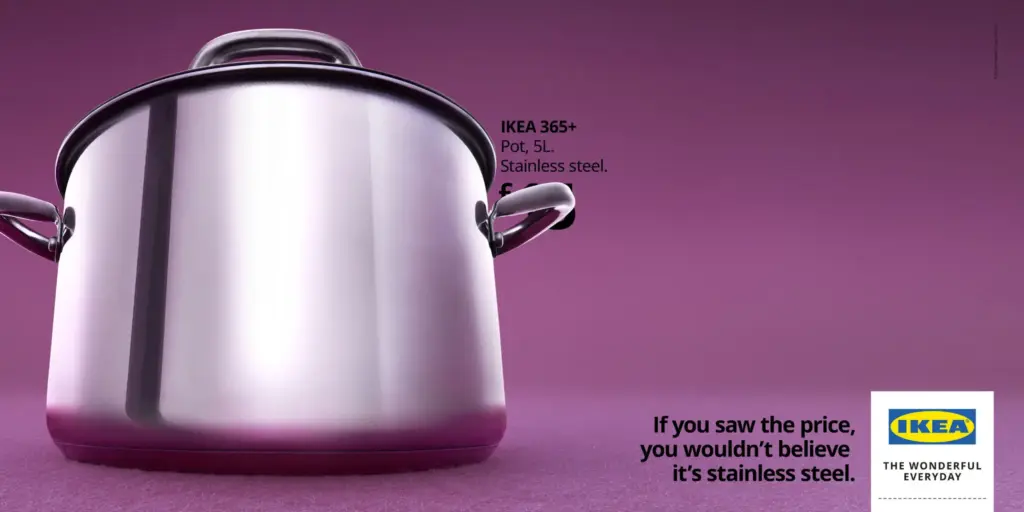
Rather than removing price information entirely, IKEA repositioned it. Cost was still part of the decision, but no longer the starting point.
Why This Is Unusual for IKEA
IKEA has long differentiated itself through radical price transparency. Prices are visible, standardized, and comparable across stores. The model encourages customers to make quick decisions based on value.
By temporarily hiding price tags, IKEA reversed that logic. Instead of asking “How cheap is this?”, customers were prompted to ask, “What is this made of?” first. For a brand that built its reputation on affordability, this is a notable shift in emphasis.
From Price First to Product First
The campaign did not argue that IKEA products are premium. Instead, it reframed from how value is perceived.
Customers were encouraged to evaluate products the way they might in higher end furniture stores, where materials and craftsmanship are noticed before cost. Only after forming an impression would price enter the equation.
According to the campaign logic, this sequence matters. Seeing a low price first can shape expectations downward. Seeing quality first can reset them.
Still Affordable, But Framed Differently
Importantly, the campaign did not signal a move away from affordability. IKEA has not announced pricing changes.
The products on display were still priced within IKEA’s usual ranges. The difference lies in presentation, not cost. In that sense, the campaign was less about changing what IKEA sells and more about changing how customers look at it.
A Response to Changing Consumer Attitudes
The timing of the campaign is also telling.
Consumers today are increasingly attentive to durability, sustainability, and material quality. Fast furniture and disposable interiors are facing more scrutiny, especially among younger buyers.
IKEA has responded to these trends by emphasizing longevity, circular design, and improved material sourcing. The hidden price campaign fits within that broader narrative.
Rather than competing only on being cheap, IKEA appears to be reinforcing the idea of long-term value.
Retail Psychology at Work
Retail environments shape behavior in subtle ways. Price tags act as anchors, setting expectations before a product is even touched.
By removing that anchor, IKEA altered the decision-making process. Customers were invited to slow down, observe, and engage. This does not mean everyone will suddenly shop differently. But even brief interruptions to habitual behavior can change perception. For IKEA, the experiment was as much about learning how customers respond as it was about sending a message.
What the Campaign Signals
IKEA’s decision to hide prices, even temporarily, signals confidence. It suggests the company believes its products can stand on their own when judged on materials and construction, not just on cost. At the same time, it reflects a broader shift in retail storytelling. Price remains important, but it no longer needs to speak first.
For a brand built on affordability, choosing to mute that message, even briefly, is unexpected. That is precisely why it worked.

