





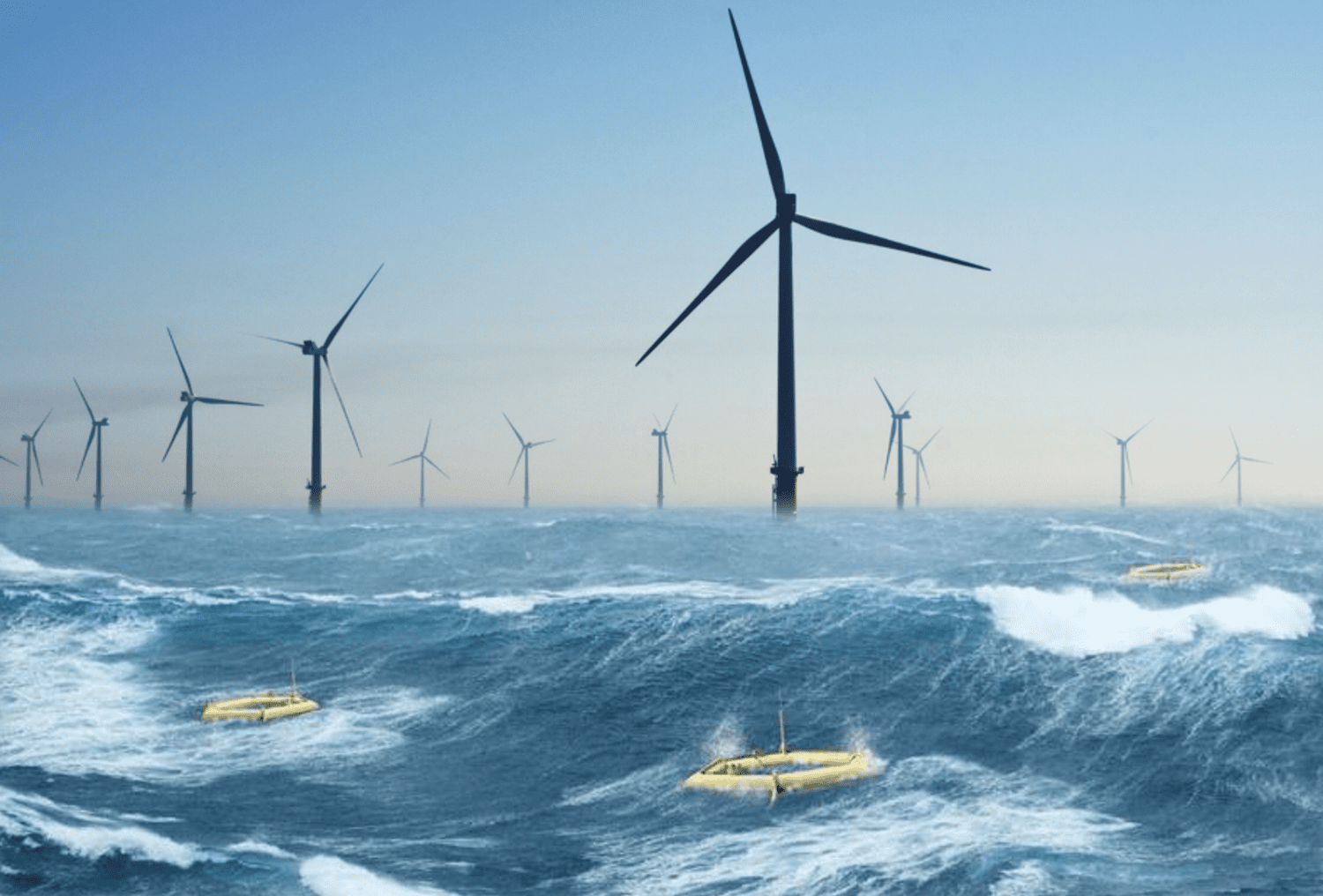
Tidal arrays are groups of underwater turbines installed in areas with strong tidal currents to generate electricity from moving seawater. In many ways, they resemble offshore wind farms, but instead of wind, they use the predictable movement of tides. This predictability is one of their main advantages. Unlike wind or solar power, which depend on weather conditions, tidal patterns can be forecast years in advance, making tidal energy a reliable component of a renewable energy mix (Coles et al., 2021).
However, tidal arrays are not simply collections of independent turbines. Once deployed at scale, they begin to interact with the surrounding water flow. As turbines extract energy, they slow down currents, which in turn affects the performance of other turbines within the array. This makes their design far more complex than it might initially seem. The layout, spacing, and number of turbines all influence total energy output, meaning that efficiency depends not only on technology but also on precise engineering and planning (Vennell et al., 2015).
Conditions required for tidal energy
Tidal arrays can only operate effectively in specific geographical conditions. The most suitable locations are narrow channels, coastal headlands, or areas between islands where tidal currents are naturally accelerated. These environments concentrate energy and create the high flow speeds necessary for electricity generation (Neill et al., 2016).
This geographical limitation means that tidal energy is not universally deployable. It is highly location-specific. The United Kingdom is particularly well-positioned because of its exposure to the Atlantic Ocean and its complex coastline, which provides access to a large share of Europe’s tidal resources. This natural advantage partly explains why the UK has become a global leader in tidal stream development.
The Nova Innovation case
A key real-world example of tidal arrays comes from Nova Innovation. In 2016, the company installed the world’s first offshore tidal array in the Shetland Islands. The system consisted of three 100 kilowatt turbines, each capable of powering up to 60 homes. While small in scale, the project demonstrated that tidal arrays can operate reliably in real conditions.
The company has since aimed to scale up its technology. Its next planned array includes turbines that generate five times more power, forming a 4 megawatt system in the Orkney Islands. As noted by Nova Innovation’s Chief Business Officer, the primary challenge now is reducing costs to make tidal energy competitive with other renewable sources (CNN, 2025).
This example highlights the broader trajectory of the industry. The technology itself is no longer purely experimental. The key question is whether it can scale economically.
Effectiveness in the energy system
From a resource perspective, tidal arrays have meaningful potential. Estimates suggest that tidal stream energy could supply a noticeable share of national electricity demand in countries with strong tidal resources. In the UK, projections indicate that tidal energy could contribute a non-trivial portion of total electricity generation if deployed at scale (Coles et al., 2021).
However, effectiveness is not only about technical potential. It is also about cost and integration. At present, tidal energy remains more expensive than established renewables such as wind and solar. The technology is still in a relatively early stage of development, with limited large-scale deployment and high upfront investment requirements (Noble et al., 2024).
Despite this, there are strong reasons to believe costs could decline over time. Other renewable technologies have followed similar paths, where early high costs decreased rapidly as deployment increased. Learning effects, improved design, and economies of scale could make tidal arrays more competitive in the future (Noble et al., 2024).
An additional advantage is system value. Because tidal energy is predictable, it can complement more volatile sources like wind and solar. This reduces uncertainty in electricity supply and can lower the need for backup generation or storage. In this sense, tidal arrays may provide value beyond their direct cost per unit of electricity.
Engineering and efficiency challenges
One of the most important challenges for tidal arrays lies in their sensitivity to design and environmental conditions. Small differences in how turbines are arranged can significantly affect total output. Even minor inaccuracies in modeling water flow can reduce efficiency and lead to lower than expected energy production (Jordan et al., 2023).
Moreover, tidal arrays do not operate in isolation. Large installations can influence regional hydrodynamics, meaning that one array can affect another. This creates coordination challenges and suggests that optimal deployment may require strategic planning rather than independent project development (Waldman et al., 2019).
Environmental considerations
The environmental impact of tidal arrays is an important aspect of their evaluation. Turbines alter water flow, which can influence sediment transport and marine ecosystems. However, current evidence suggests that smaller arrays tend to have impacts within the range of natural environmental variability (Robins et al., 2014).
At the same time, larger scale deployments may introduce more significant changes, particularly in sediment dynamics and ecological interactions. This means that environmental effects are not negligible, but they are also not inherently prohibitive. Careful site selection and monitoring remain essential.
Conclusion
Tidal arrays represent a promising but still developing renewable energy technology. They offer a unique combination of predictability and renewable generation, which could play a valuable role in future energy systems. However, their deployment is constrained by geography, cost, and engineering complexity.
The Nova Innovation example illustrates the current stage of the industry. The technology works, but scaling it economically remains the central challenge. If costs decline and deployment increases, tidal arrays could become an important complement to other renewable sources, contributing to a more stable and diversified energy mix.
References
CNN. (2025). Nova Innovation tidal array interview and project details.
Coles, D., Angeloudis, A., Greaves, D., Hastie, G., Lewis, M., Mackie, L., McNaughton, J., Miles, J., Neill, S., Piggott, M., Risch, D., Scott, B., Sparling, C., Stallard, T., Thies, P., Walker, S., White, D., Willden, R., & Williamson, B. (2021). A review of the UK and British Channel Islands practical tidal stream energy resource.
Jordan, C., Coles, D. S., Johnson, F., & Angeloudis, A. (2023). On tidal array layout sensitivity to regional hydrodynamics representation.
Neill, S. P., Hashemi, M. R., & Lewis, M. J. (2016). Tidal energy leasing and tidal phasing. Renewable Energy, 85, 580-587.
Noble, D. R., Grattan, K., & Jeffrey, H. (2024). Assessing the costs of commercialising tidal energy in the UK. Energies, 17
Robins, P. E., Neill, S. P., & Lewis, M. J. (2014). Impact of tidal-stream arrays in relation to the natural variability of sedimentary processes. Renewable Energy, 72, 311-321.
Vennell, R., Funke, S. W., Draper, S., Stevens, C., & Divett, T. (2015). Designing large arrays of tidal turbines: A synthesis and review. Renewable and Sustainable Energy Reviews, 41, 454-472.
Waldman, S., Weir, S., O’Hara Murray, R. B., Woolf, D. K., & Kerr, S. (2019). Future policy implications of tidal energy array interactions. Marine Policy, 108.