





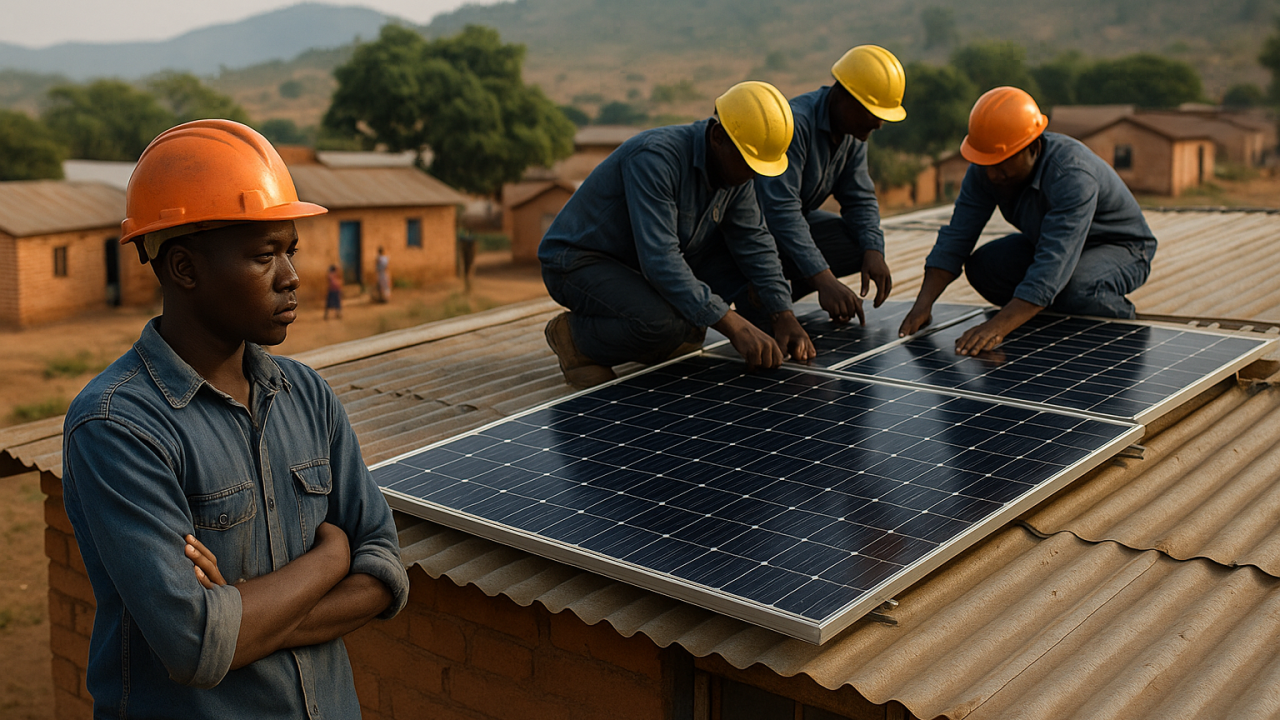
Africa is frequently described as an energy constrained continent. While this description reflects the reality of low electricity access, it fails to capture a parallel and equally important reality: Africa possesses one of the largest untapped renewable energy systems in the world. According to the World Economic Forum, up to 76% of Africa’s projected electricity demand could be met by renewable energy sources by 2040 (World Economic Forum, 2024).
This estimate is not based on abstract resource availability alone. It is derived from a comprehensive assessment of existing and planned renewable power plants across the continent, compiled into the Renewable Power Plant Database Africa. The result challenges the common assumption that Africa’s energy future must remain fossil heavy due to development constraints. Instead, it suggests that renewable energy is already structurally embedded in Africa’s electricity expansion trajectory.
However, potential should not be confused with inevitability. Translating technical capacity into reliable, affordable electricity requires system level coordination across infrastructure, institutions, finance, and regional markets.
Estimating renewable potential through existing and planned capacity
Many earlier assessments of Africa’s renewable energy prospects relied on top-down resource mapping, estimating solar irradiation, wind speeds, or hydrological flows. While useful for understanding physical potential, these approaches often exaggerate what can realistically be deployed within political, financial, and institutional constraints.
The Renewable Power Plant Database Africa adopts a different methodology. Instead of asking how much renewable energy Africa could theoretically generate, it examines what is already built or planned under current policy and investment conditions. According to the World Economic Forum (2024), this bottom-up approach indicates that renewables could supply roughly three quarters of Africa’s electricity demand by 2040 if existing project pipelines are completed and integrated effectively.
This distinction matters. The estimate does not assume a sudden policy revolution or speculative technological breakthroughs. It reflects the continuation and coordination of projects that are already under development.
Hydropower’s dominant role in current planning
One of the most striking outcomes of the database analysis is the continued dominance of hydropower in Africa’s renewable electricity portfolio. According to the World Economic Forum (2024), hydropower accounts for approximately 82% of the renewable generation capacity identified in the database.
This reflects historical development patterns rather than future optimization. Large hydropower projects have long served as the backbone of electricity systems in Central and East Africa, where major river basins offered early opportunities for centralized generation. Countries such as Ethiopia, the Democratic Republic of Congo, and Zambia built national power systems around hydropower long before large scale solar and wind technologies became commercially viable.
From a system perspective, hydropower provides dispatchable capacity and grid stability, attributes that are particularly valuable in electricity systems with limited transmission infrastructure. Large reservoirs also enable seasonal balancing, reducing short-term supply volatility.
At the same time, reliance on hydropower concentrates risk. Large projects involve long construction timelines, high upfront capital requirements, and exposure to hydrological variability. Peer reviewed research on highly renewable energy systems for Africa emphasizes that while hydropower remains important, future system resilience requires diversification rather than continued dependence on a single dominant technology (Oyewo et al., 2023).
The expanding role of solar and wind energy
Solar photovoltaic energy represents the most scalable complement to hydropower in Africa’s energy transition. Academic literature consistently highlights solar PV as a central driver of future electricity expansion due to its modularity, declining costs, and wide geographic availability across the continent (Oyewo et al., 2023).
Unlike large hydropower, solar projects can be deployed incrementally, reducing exposure to cost overruns and political delays. Solar PV is also suitable for both centralized grid connected systems and decentralized applications, making it particularly relevant in regions where grid expansion remains slow.
Wind energy plays a more geographically concentrated role, with strong potential in North Africa, coastal regions, and parts of East and Southern Africa. While wind currently accounts for a smaller share of installed capacity, its generation profile complements solar output, improving system balance when integrated effectively.
Importantly, the literature does not suggest that Africa’s renewable future will be purely variable. Instead, studies emphasize hybrid systems combining hydropower, solar, wind, and storage technologies to achieve reliability and cost efficiency at scale (Oyewo et al., 2023).
Energy access and the gap between capacity and service delivery
Despite its renewable potential, Africa remains the region with the lowest electricity access rates globally. According to international energy data referenced in system level studies, approximately 600 million people in Sub Saharan Africa lack access to electricity, highlighting a persistent gap between generation capacity and delivered energy services (Pappis et al., 2019).
This gap underscores a critical point: building renewable generation capacity does not automatically translate into universal access. Large-scale projects often feed national grids that primarily serve urban and industrial consumers, while rural and peri-urban communities remain disconnected.
Decentralized solutions, including mini grids and off-grid solar systems, have demonstrated strong potential to accelerate electrification where grid extension is uneconomical. However, these systems face their own challenges, including financing constraints, regulatory uncertainty, and limited long-term maintenance capacity.
Academic research emphasizes that Africa’s energy transition must integrate electrification objectives directly into system planning rather than treating access as a secondary outcome of generation expansion (Oyewo et al., 2023).
Regional integration as a system enabler
Regional power pools represent one of the most underutilized tools in Africa’s renewable transition. Cross-border electricity trade enables countries to balance variable renewable output, reduce reserve requirements, and exploit differences in resource endowments.
Energy system modeling conducted for the European Commission shows that regional interconnections allow African countries to optimize investment timing, reduce total system costs, and improve reliability under high renewable penetration scenarios (Pappis et al., 2019).
Hydropower rich countries can export electricity during periods of surplus, while solar rich regions contribute during daylight hours. This coordination becomes increasingly important as variable renewables scale up.
However, physical interconnectors alone are insufficient. Effective regional markets require harmonized regulations, transparent pricing mechanisms, and political coordination. Without these institutional foundations, renewable investments risk becoming stranded within fragmented national systems.
Financing the renewable transition
Achieving high renewable penetration by 2040 requires a significant increase in clean energy investment. Renewable technologies reduce long-term operating costs but are capital-intensive upfront, shifting financial risk toward early project stages.
The World Economic Forum identifies financing as one of the central bottlenecks in Africa’s clean energy transition and has launched initiatives aimed at mobilizing private capital into emerging market renewable projects (World Economic Forum, 2024). These initiatives focus on reducing perceived risk through blended finance, public private partnerships, and improved policy coordination.
Academic studies caution that finance alone is insufficient. Weak permitting processes, uncertain tariff structures, currency risk, and limited institutional capacity continue to deter investment even where renewable projects are technically viable (Pappis et al., 2019; Oyewo et al., 2023).
From technical potential to system transformation
The finding that renewables could meet 76% of Africa’s electricity demand by 2040 should be interpreted as a conditional opportunity rather than a forecast. It demonstrates that resource availability is not a binding constraint. Instead, the outcome depends on system design, institutional capacity, regional coordination, and investment alignment.
Africa’s energy future will remain heterogeneous. Some countries may move rapidly toward renewable heavy systems, while others follow hybrid pathways shaped by existing infrastructure and development priorities. What is clear is that renewable energy is no longer a marginal option. It is already embedded in Africa’s electricity expansion pipeline.
The central challenge is not identifying potential, but building the systems capable of delivering it.
References
Oyewo, A.S., Sterl, S., Khalili, S., & Breyer, C. (2023). Highly renewable energy systems in Africa: Rationale, research, and recommendations. Joule, 7, 1437-1470. Elsevier.
Pappis, I., Howells, M., Sridharan, V., Usher, W., Shivakumar, A., Gardumi, F., & Ramos, E. (2019). Energy Projections for African Countries. JRC Technical Report.
World Economic Forum. (2024). 76% of Africa’s Energy Could Be Renewable by 2040.

