





Introduction
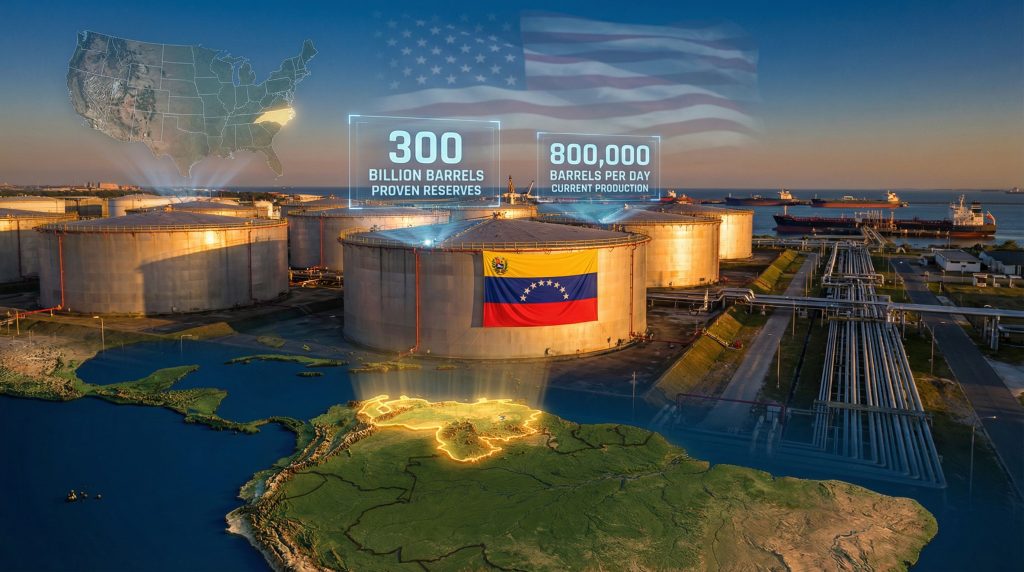
Venezuela is frequently described as the country with the largest oil reserves in the world. With officially reported proven reserves approaching 300 billion barrels, it occupies a unique position in global energy statistics. However, this characterization often obscures a more fundamental reality: Venezuela’s energy challenge is not defined by scarcity of resources, but by scarcity of conversion capacity. Geological abundance does not automatically translate into economic power. Only resources that can be transformed, transported, refined, financed, and legally traded constitute usable energy.
This article treats Venezuela’s energy system as an industrial system rather than a political one. It distinguishes between three separate categories:
- Geological existence of hydrocarbons,
- Technical feasibility of extraction, and
- Economic usability within global markets.
Venezuela’s weakness lies in the third category. The country controls some of the world’s largest hydrocarbon inventories, yet it does not control the infrastructure that converts those inventories into energy supply. This distinction shapes the entire structure of Venezuelan energy economics.
Section 1
What Venezuela Actually Holds Underground: Reserves, Recoverability, and Usability
Venezuela’s proven oil reserves are officially reported at close to 300 billion barrels, placing it above Saudi Arabia and Russia in reserve rankings (OPEC, 2024). Proven reserves describe hydrocarbons that are known to exist under defined geological conditions and can be extracted with reasonable certainty. They do not describe production speed, production cost, or economic viability.
The majority of these reserves are concentrated in the Orinoco Oil Belt, one of the largest continuous heavy oil accumulations in the world. The United States Geological Survey estimates that the Orinoco region contains more than one trillion barrels of oil in place, with a mean estimate of approximately 513 billion barrels that are technically recoverable using existing extraction technologies (USGS, 2009). Technical recoverability, however, refers only to engineering feasibility under idealized conditions. It does not incorporate financial constraints, infrastructure availability, or market access.
Orinoco crude is chemically and physically different from conventional oil. Its API gravity typically ranges from 4 to 16 degrees, compared with more than 35 degrees for benchmark crudes such as Brent and West Texas Intermediate (USGS, 2009). Such low API gravity indicates extremely dense and viscous hydrocarbons. These oils do not flow naturally and cannot be transported or refined without extensive processing. Their high sulfur and metal content further complicates refining and increases costs.
Extraction therefore requires thermal stimulation, artificial lift, horizontal drilling, and continuous energy input. After extraction, the crude must be diluted or upgraded into synthetic crude through capital-intensive chemical processes before it can enter pipelines or refineries (USGS, 2009). Koning (2003) shows that heavy oil systems behave more like mining operations than conventional petroleum fields, because production depends on continuous surface infrastructure and sustained industrial coordination.
This transforms Venezuela’s oil from a natural resource into an industrial project. Its value depends not only on geology but on long-term institutional and financial stability. Gallegos (2016) emphasizes that Venezuela’s historical oil prosperity depended on the integration of extraction, upgrading, refining, and export logistics into a coherent system. Once that system weakened, reserve size alone lost economic meaning.
Wilpert (2005) similarly argues that Venezuela never possessed full autonomy over its petroleum value chain. Even during periods of strong state control, the most technologically complex segments remained dependent on foreign capital, expertise, and downstream infrastructure. Extra-heavy oil magnifies this dependence because its conversion lies at the frontier of petroleum engineering.
For this reason, Venezuela’s oil wealth must be interpreted as conditional. Proven reserves establish geological certainty. Technical recoverability establishes engineering possibilities. Only economically usable production reflects real energy power. In Venezuela, the distance between these categories is unusually large.
Section 2
Why Venezuelan Oil Only Matters If U.S. Energy Companies Are Involved
Once the industrial nature of Venezuela’s oil is understood, the role of U.S. energy companies becomes structural rather than political. Extra-heavy crude cannot be monetized through ownership alone. It requires access to advanced upstream engineering, upgrading technology, compatible refining capacity, pipeline infrastructure, shipping logistics, insurance systems, and international finance. U.S. energy firms occupy central positions in almost all of these segments.
In the context of the current production constraints and renewed U.S. involvement in Venezuela’s oil sector, these companies are therefore not merely potential partners but the primary industrial actors through which any effective “control” or revival of Venezuelan oil production can realistically occur.
Chevron represents the most direct operational bridge between Venezuelan reserves and global markets. It possesses long experience in heavy-oil systems and maintains physical integration with Venezuela’s upstream production and blending infrastructure. Without firms capable of managing technically demanding reservoirs, extraction itself becomes inefficient or impossible (USGS, 2009).
ExxonMobil occupies a different but equally important position. It controls some of the world’s most complex refining systems and possesses the financial scale required for projects that operate on multi-decade horizons. Gallegos (2016) shows that Venezuela’s export capacity has always depended on access to foreign refining infrastructure. Extra-heavy oil intensifies this dependency because only a limited number of refineries can process it economically.
ConocoPhillips contributes technical expertise in complex upstream projects. Hammond (2011) emphasizes that in capital-intensive resource sectors, operational competence often matters more than formal ownership. Heavy-oil extraction belongs to this category.
Kinder Morgan controls critical midstream infrastructure. In heavy-oil systems, pipelines are not auxiliary components. They are part of production itself. Without transport capacity, extraction loses economic meaning.
Valero represents the downstream gatekeeper. Its refineries possess the delayed coking and hydroprocessing capacity required to handle heavy and high-sulfur feedstocks. Historically, Venezuela’s oil exports were viable largely because of integration with U.S. Gulf Coast refining systems (Gallegos, 2016).
Together, these companies form a distributed conversion network:
- Chevron enables extraction,
- ExxonMobil and Valero enable refining,
- ConocoPhillips enables complex upstream engineering,
- Kinder Morgan enables physical movement.
Venezuela controls the reserves. These firms control the conversion system.
Energy power flows from the latter, not the former.
Section 3
The Current Situation: Chevron, Sanctions, and the Limits of Production Recovery
Venezuela’s oil production today remains far below its historical capacity. At the end of the 1990s, production exceeded 3 million barrels per day. By contrast, recent estimates place output between roughly 700,000 and 900,000 barrels per day, depending on the reporting month and methodology (OPEC, 2025; U.S. Energy Information Administration [EIA], 2025). This collapse is not explained by resource depletion. It reflects the deterioration of infrastructure, chronic underinvestment, loss of skilled labor, and restricted access to international finance, technology, and logistics.
The most significant development in recent years has been the limited re-entry of Chevron under a specific U.S. government license. In November 2022, the U.S. Treasury’s Office of Foreign Assets Control issued General License 41, authorizing Chevron to resume certain oil production and export activities in its joint ventures with PDVSA (U.S. Department of the Treasury, 2022). This authorization allows Chevron to recover outstanding debt through oil exports, but it does not permit cash payments to the Venezuelan state.
This arrangement illustrates how Venezuelan oil production is constrained less by geology than by access to global market infrastructure. Chevron’s license restores critical functions that Venezuela itself cannot provide: legal market access, shipping insurance, tanker chartering, equipment imports, and refinery contracts. Reuters reports that most Venezuelan crude exports that comply with international regulations are now channeled through Chevron’s operations and flow primarily to U.S. Gulf Coast refineries capable of processing heavy crude (Reuters, 2024; Reuters, 2025).
The scale of Chevron’s contribution also demonstrates the structural limits of recovery. Even with Chevron operating, production growth has been modest. EIA (2025) data indicate that Chevron-linked projects account for only a fraction of Venezuela’s total output and cannot compensate for decades of industrial decay. This confirms that sanctions relief alone does not rebuild production capacity. The binding constraint is infrastructure, not authorization.
Sanctions affect Venezuela’s oil sector by disabling the systems that allow oil to become a tradable commodity. These include international banking channels, maritime insurance, tanker chartering, equipment supply chains, refinery access, and contract enforcement. The International Energy Agency (2024) emphasizes that oil production is an integrated supply-chain activity in which disruptions in finance or logistics immediately translate into production constraints. Venezuela exemplifies this principle.
Even when oil can technically be produced, exporting it requires shipping insurance, port access, refinery compatibility, dollar settlement mechanisms, and legal clarity under sanctions law. Without this, production becomes economically meaningless. The United States occupies a dominant position in each of these domains: it hosts the world’s largest heavy-crude refining system, controls major maritime insurance and shipping networks, and anchors the global dollar-clearing system.
This configuration means that Venezuela’s oil sector remains structurally embedded within the U.S.-centered energy system. Chevron functions as a legal and technical bridge between Venezuelan geology and global markets. Without such a bridge, Venezuelan oil remains largely stranded regardless of political developments.
The current situation therefore reveals a fundamental reality. Venezuela cannot expand production independently. Its oil only becomes economically relevant when it is integrated into external conversion systems that it does not control.
Section 4
Natural Gas as Venezuela’s Only Short-Term Energy Lever
In contrast to extra-heavy oil, natural gas offers Venezuela a realistic opportunity for near-term energy recovery. Venezuela holds the largest proven gas reserves in Latin America and ranks among the top ten globally, with reserves exceeding 200 trillion cubic feet (OPEC, 2024). These include both associated gas in oil fields and large non-associated offshore deposits, particularly in the Caribbean maritime zone.
Gas differs fundamentally from heavy oil in its industrial requirements. It does not require chemical upgrading. Once extracted, it can be transported directly through pipelines, processed in relatively simple facilities, and used for electricity generation, petrochemicals, fertilizers, and industrial heating. The infrastructure required is capital-intensive but modular and scalable. Individual projects can be developed incrementally rather than as part of a single massive reconstruction effort.
Wilpert (2005) observes that Venezuela historically treated gas as secondary to oil. Investment and policy focused overwhelmingly on crude exports, while gas was reinjected, flared, or left undeveloped. This bias deprived Venezuela of the very resource that could have stabilized its domestic energy system and diversified its industrial base.
From an economic perspective, this represents a major lost opportunity. Gas is not merely an export commodity. It is an enabling resource that supports electricity reliability, industrial production, and energy security. The International Energy Agency (2023) emphasizes that natural gas remains a central transitional fuel in global energy systems because of its flexibility and compatibility with variable renewable energy.
Gas projects also reduce institutional risk. Hammond (2011) shows that resource-based development is more successful when projects can be implemented incrementally and financed independently. Gas pipelines, offshore platforms, and processing plants can be developed step by step, whereas heavy-oil systems require full industrial reconstruction before meaningful production can occur.
For Venezuela, gas therefore represents fast power. It offers the possibility of stabilizing electricity supply, reducing reliance on imported fuels, supporting petrochemical production, and generating export revenue within a realistic timeframe. Oil, by contrast, remains slow power, dependent on generational reconstruction of industrial capacity.
Any credible Venezuelan energy strategy must therefore be gas-first. Oil can remain a strategic reserve. Gas must become the operational foundation.
Section 5
Strategic Outlook: Conversion Capacity as the Source of Energy Power
Venezuela’s energy future is defined not by the volume of resources it controls, but by the speed at which it can rebuild conversion capacity. Oil, gas, and minerals exist on different timelines and require different institutional frameworks.
Extra-heavy oil remains Venezuela’s largest stored energy asset. However, its mobilization depends on rebuilding an entire industrial ecosystem: upstream engineering, upgrading plants, hydrogen supply, compatible refineries, pipelines, shipping logistics, insurance markets, and access to finance. As Koning (2003) shows, unconventional petroleum systems function only when industrial continuity is sustained over decades. Venezuela currently lacks the conditions required for such continuity.
Natural gas operates on a shorter and more realistic horizon. It can restore domestic energy functionality, rebuild industrial credibility, and generate economic value without reconstructing the entire petroleum system. Gas is therefore Venezuela’s only viable short-term energy lever.
Minerals in the Orinoco Mining Arc represent potential future relevance in the energy transition, but they face the same institutional and infrastructural barriers as heavy oil. They remain optional power, not immediate leverage.
This hierarchy defines Venezuela’s energy system:
- Oil: long-term strategic potential
- Gas: short-term economic functionality
- Minerals: conditional future relevance
Energy power does not flow from reserves. It flows from conversion systems.
Conclusion
Venezuela possesses one of the world’s largest hydrocarbon endowments and substantial mineral resources essential for the energy transition. Yet its economic weakness is not a paradox of abundance. It is a consequence of missing conversion capacity. Proven reserves describe geological reality. Only usable energy creates power.
Oil will shape Venezuela’s long-term strategic relevance.
Gas will shape its short-term economic recovery.
Infrastructure will determine whether either becomes real.
Until conversion capacity is rebuilt, Venezuela’s extraordinary geology will remain potential rather than power.
Reference List
Gallegos, R. (2016). Crude nation: How oil riches ruined Venezuela. University of Nebraska Press.
Hammond, J. L. (2011). The resource curse and oil revenues in Angola and Venezuela. Science & Society, 75(3), 348–378.
International Energy Agency. (2023). World energy outlook 2023. IEA.
International Energy Agency. (2024). Oil market report. IEA.
Koning, T. (2003). Oil and gas production from basement reservoirs: Examples from Indonesia, USA and Venezuela. Geological Society Special Publication No. 214, pp. 83–92.
OPEC. (2024). Annual statistical bulletin 2024. Organization of the Petroleum Exporting Countries.
OPEC. (2025). Monthly oil market report. Organization of the Petroleum Exporting Countries.
Reuters. (2024). Chevron lifts Venezuelan oil exports under U.S. license.
Reuters. (2025). Venezuela oil output edges higher on Chevron projects, but capacity constraints remain.
United States Geological Survey. (2009). An estimate of recoverable heavy oil resources of the Orinoco Oil Belt, Venezuela (Fact Sheet 2009–3028).
U.S. Department of the Treasury. (2022). Issuance of General License 41 authorizing certain transactions involving Chevron Corporation and its subsidiaries in Venezuela. Office of Foreign Assets Control.
U.S. Energy Information Administration. (2025). International energy statistics: Venezuela.
Wilpert, G. (2005). The economics, culture, and politics of oil in Venezuela. Venezuela Analysis.

