





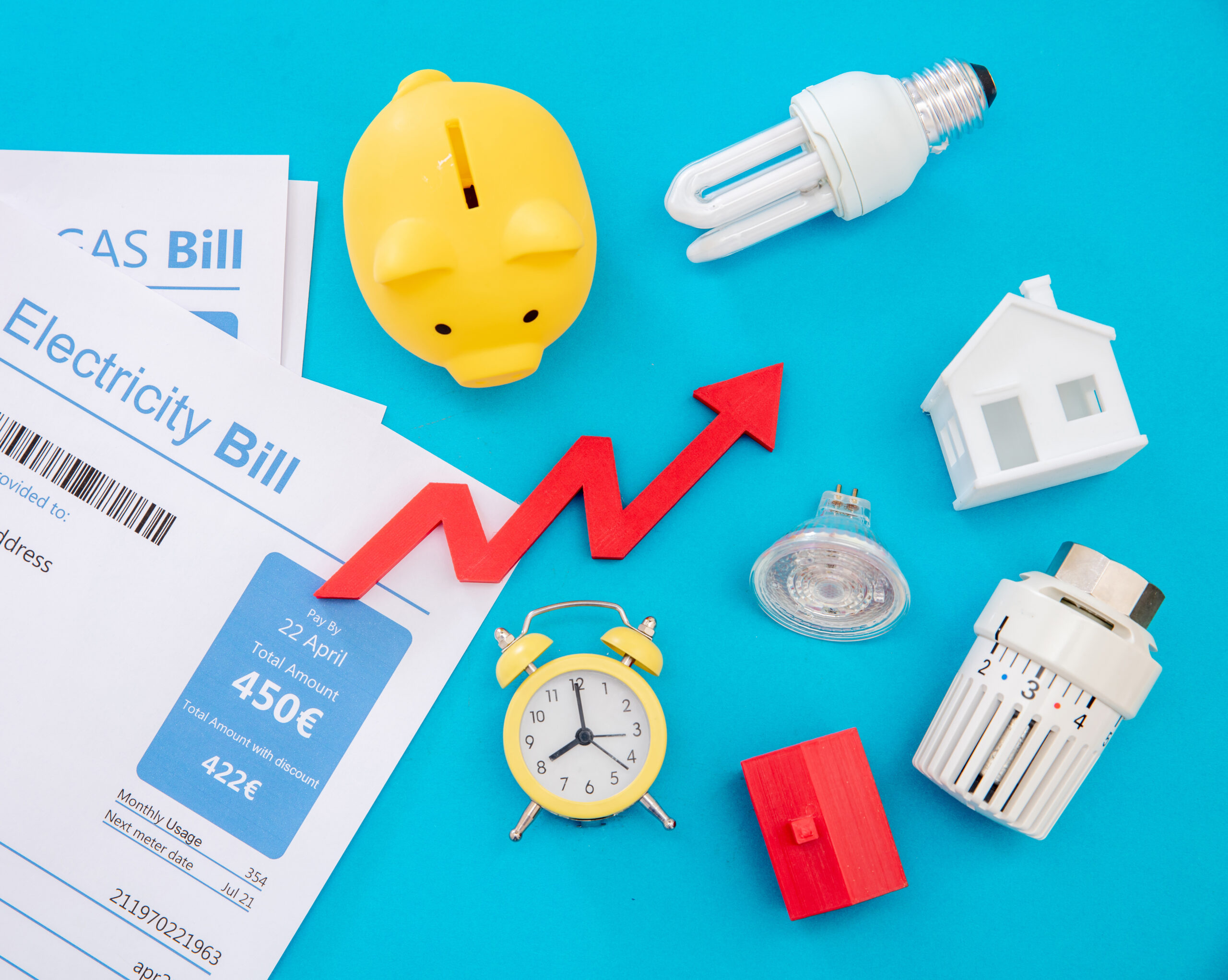
Electricity bills across advanced economies have been rising steadily, and in some places sharply. In the United States, households that rely primarily on electricity for heating are expected to spend about 4 percent more this winter than last year. In California, average residential electricity prices are roughly one third higher than they were six years ago (US Energy Information Administration, 2024). Similar pressures are visible in the United Kingdom and parts of Europe.
The political explanation is often simple. Wind and solar are blamed for pushing costs higher. The economic explanation is more complex. Rising bills reflect how electricity markets are structured, how grids are financed, what fuels still determine prices at the margin, and how fast demand is growing.
Grid Investment and Network Costs
A large portion of electricity bills has nothing to do with generation. It covers transmission and distribution. These are the costs of poles, wires, substations, maintenance, grid resilience, and upgrades needed to handle both higher demand and more volatile weather.
In the United Kingdom, the energy regulator Ofgem has approved roughly 28 billion pounds of network investment for the current regulatory period. Ofgem has stated that while these upgrades are intended to improve reliability and reduce long-term bottlenecks, part of the cost will be recovered through consumer bills (Ofgem, 2023).
California illustrates the same mechanism in a different regulatory environment. Academic research and regulatory analysis show that wildfire mitigation, grid hardening, and legacy infrastructure costs have been major contributors to rising residential electricity prices, rather than a simple increase in the cost of power generation itself (Singh et al., 2025).
Grid spending is therefore not a future concern. It is already embedded in today’s electricity bills.
Renewables Are Cheap, but They Do Not Set the Price
Wind and solar power are now among the cheapest sources of new electricity generation in many regions (International Renewable Energy Agency, 2024).
However, cheaper generation does not automatically lead to lower bills. The reason lies in how wholesale electricity prices are set.
In both the United States and the United Kingdom, wholesale electricity markets largely operate on marginal pricing. The most expensive generator needed to meet demand in a given hour sets the price for all electricity sold during that period. In practice, that generator is often a natural gas plant (UK House of Commons Library, 2022; US Energy Information Administration, 2024).
As long as gas remains necessary to balance the system, especially during peak demand or periods of low renewable output, gas prices will continue to exert a disproportionate influence on electricity prices. This helps explain why electricity prices rose sharply during periods of gas market volatility, even in systems with growing renewable capacity.
Blaming renewables for higher prices therefore misidentifies the main cost driver. In many cases, renewables are being added precisely because they are cost competitive.
Demand Growth and the Role of Data Centers
Another major driver of rising electricity costs is demand growth.
Electricity systems are built to meet peak demand rather than average consumption. When demand increases quickly, grids require new capacity, new connections, and additional reliability margins. These costs are ultimately socialized across consumers.
Recent demand growth is increasingly driven by data centers, particularly those supporting artificial intelligence workloads. According to the International Energy Agency (2024), a single large AI focused data center can consume as much electricity as roughly 100,000 households.
Academic research confirms that concentrated, continuous demand from data centers places stress on local grids and accelerates the need for infrastructure investment, especially in regions where facilities cluster geographically (Shehabi et al., 2016). In parts of the United States, electricity demand is forecast to rise by more than 15 percent over the next few years, driven in large part by these developments (Wilson et al., 2024).
This has already triggered political and social resistance. Several large data center projects in the United States have faced delays or cancellations following local opposition, and policymakers in multiple states are now debating whether large technology firms should shoulder a greater share of grid upgrade costs.
Why Bills Rise Even Without Higher Household Usage
Electricity bills are not based solely on how much power a household consumes. They also include fixed charges, delivery charges, and cost recovery mechanisms linked to infrastructure investment and system reliability.
When grids are upgraded or capacity markets signal future scarcity, utilities recover these costs through regulated tariffs. As a result, bills can rise even if household electricity usage remains flat.
Regulatory and academic analyses emphasize that this structure reflects how capital-intensive electricity systems are financed, rather than a short-term policy failure (Joskow, 2009).
Putting the Pieces Together
Rising electricity bills are not the result of a single technology or policy choice.
They reflect four overlapping forces.
First, grid infrastructure costs are increasing as systems are modernized, expanded, and made more resilient (Ofgem, 2023)
Second, marginal pricing means fossil fuels, especially natural gas, still set wholesale electricity prices in many hours, even when renewables supply a large share of total electricity (UK House of Commons Library, 2022).
Third, electricity demand is rising rapidly, driven in part by data centers and electrification trends, forcing grids to expand capacity at an accelerated pace (International Energy Agency, 2024; Shehabi et al., 2016).
Fourth, the structure of electricity tariffs spreads these system-wide costs across consumers, regardless of individual consumption patterns (Joskow, 2008).
The result is a system in which electricity can become cleaner and cheaper to produce, yet more expensive to deliver. Understanding this distinction is essential for any serious discussion about energy costs, climate policy, and the future of power markets.
References
International Energy Agency. (2024). Energy and AI: The implications of artificial intelligence for energy systems. IEA. Retrieved from https://www.iea.org
International Renewable Energy Agency. (2024). Renewable power generation costs in 2023. IRENA. Retrieved from https://www.irena.org
Joskow, P. L. (2008). Lessons learned from electricity market liberalization. Energy Journal, 9-42.
Ofgem. (2023). RIIO 2 final determinations: Electricity transmission and gas distribution. Office of Gas and Electricity Markets. Retrieved from https://www.ofgem.gov.uk
Shehabi, A., Masanet, E., Sartor, D., Smith, S., Koomey, J., Horner, N., Azevedo, I., & Brown, R. (2016). United States data center energy usage report. Lawrence Berkeley National Laboratory.
Singh, M., Ong, A., & Sud, R. (2025). Wires and fire: Wildfire investment and network cost differences across California’s power providers. The Electricity Journal, 38(3), 107475.
https://doi.org/10.1016/j.tej.2025.107475
UK House of Commons Library. (2022). Electricity pricing and marginal cost in the UK power market. House of Commons Library Research Briefing.
US Energy Information Administration. (2024). Winter fuels outlook. EIA. Retrieved from https://www.eia.gov/outlooks/steo/
US Energy Information Administration. (2024). Average price of electricity to residential customers by state. EIA. Retrieved from https://www.eia.gov/electricity/data/browser/
Wilson, J.D., Zimmerman, Z., & Gramlich, R. (2024). Strategic Industries Surging: Driving US Power Demand. Grid Strategies.