





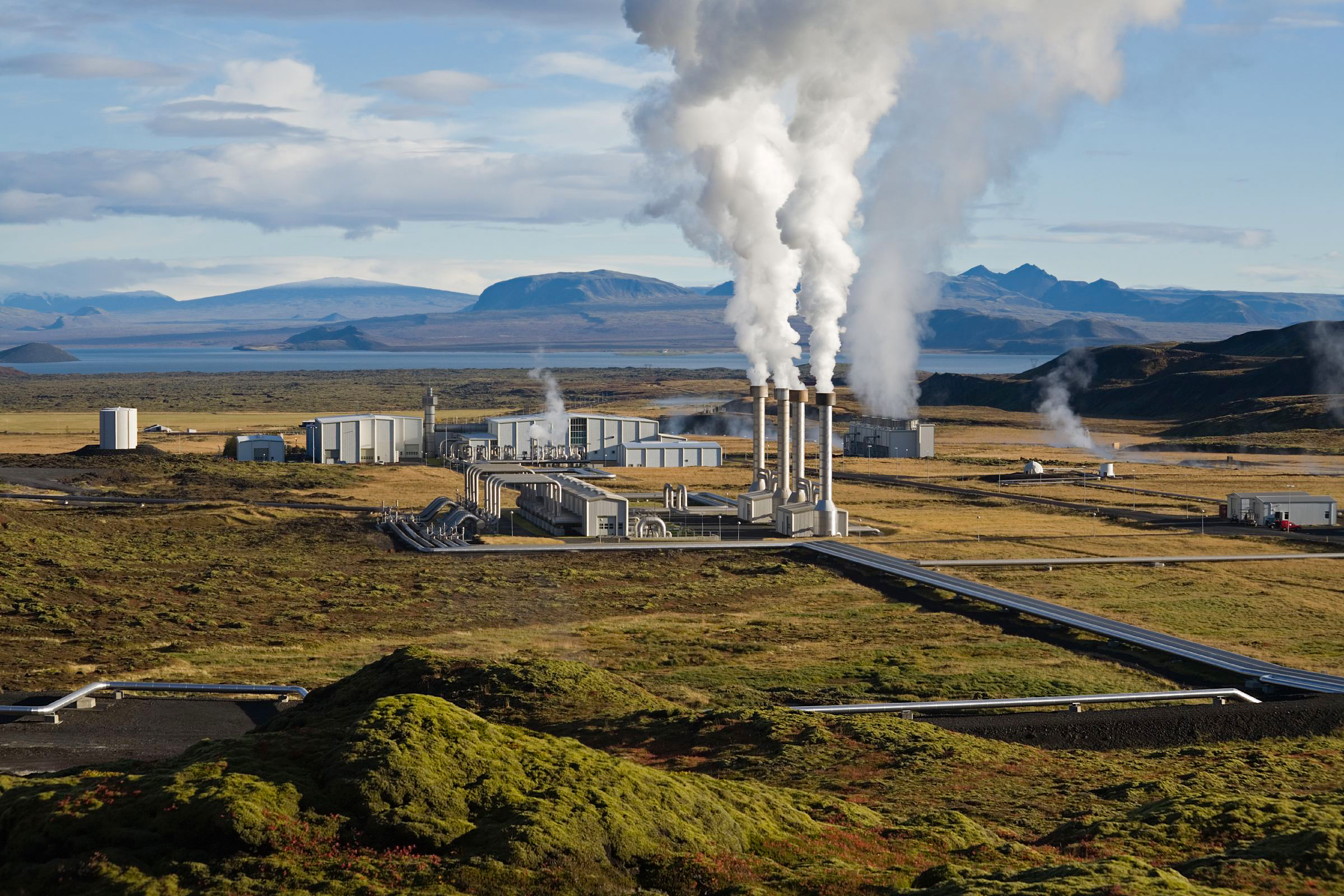
Iceland’s energy system is shaped first and foremost by geology. The country lies directly on the Mid-Atlantic Ridge, where the Eurasian and North American tectonic plates are slowly pulling apart. This makes Iceland one of the few places on Earth where volcanic and geothermal activity is accessible at relatively shallow depths. The Earth’s crust in this region is thinner than average, allowing heat from below the surface to be harnessed more easily than in most other countries (Lyons, 2017).
This geological setting provides Iceland with a steady and locally available source of geothermal energy. Underground heat warms groundwater, producing hot water and steam that can be used directly or converted into electricity. Unlike fossil fuels, this energy source is continuously replenished by natural geological processes.
Geothermal Energy and Everyday Energy Use
Geothermal energy plays a central role in Iceland’s energy consumption, particularly through direct use rather than electricity generation alone. Extensive district heating systems distribute hot water from geothermal fields to towns and cities through insulated pipe networks. This heat is used for space heating, hot water, and a range of everyday applications (Martorella & Vargas, 2018).
Today, more than 90% of Icelandic households are heated using geothermal systems. This includes not only residential heating but also warming sidewalks, melting snow on streets, and supplying hot water to swimming pools and public facilities. The direct use of geothermal heat reduces conversion losses and significantly lowers overall energy demand (Jónsson & Rastrick, 2017).
As a result, geothermal energy accounts for a large share of Iceland’s primary energy use, even though it contributes a smaller share of electricity generation.
Hydropower and Electricity Production
Electricity generation in Iceland relies primarily on hydropower. The country’s climate and topography support this model. Large glaciers, high levels of precipitation, and steep terrain create powerful river systems that are well-suited for hydroelectric generation. Meltwater from glaciers feeds rivers that drive turbines in large-scale hydroelectric plants (Martorella & Vargas, 2018).
Hydropower supplies the majority of Iceland’s electricity, while geothermal power provides most of the remainder. Together, these two sources account for virtually all electricity generation in the country, resulting in one of the lowest-carbon electricity systems globally (National Energy Authority of Iceland, 2023).
Wind and solar power exist on a limited scale but play only a minor role due to climatic constraints and the already abundant availability of geothermal and hydropower resources.
Policy Choices and Long-Term Planning
Iceland’s clean energy system did not develop automatically. While geology provided the opportunity, institutional choices determined the outcome. In the early twentieth century, Iceland relied heavily on imported coal and oil, which were expensive and vulnerable to supply disruptions. This created strong incentives to invest in domestic energy sources.
Public ownership of energy infrastructure, coordinated national planning, and gradual expansion of district heating networks allowed geothermal energy to scale across the country. Rather than pursuing rapid, centralized industrialization, Iceland developed its energy system incrementally, adapting technologies to local conditions and building public trust in geothermal solutions (Jónsson & Rastrick, 2017).
This approach embedded renewable energy into everyday life and reduced resistance to infrastructure development.
Going Deeper: Advanced Geothermal Projects
Iceland continues to explore ways to expand geothermal energy potential. One of the most ambitious initiatives is the Iceland Deep Drilling Project, which aims to access supercritical geothermal fluids at extreme temperatures near magma intrusions. These fluids contain significantly more energy than conventional geothermal reservoirs and could increase electricity output per well if successfully harnessed (Friðleifsson et al., 2020).
While these projects remain experimental and technically challenging, they illustrate how Iceland is attempting to push the limits of geothermal technology rather than relying solely on existing capacity.
Limits to Replication
Although Iceland is often cited as a model for clean energy, its experience is difficult to replicate elsewhere. Few countries possess similar geothermal conditions or the same combination of hydrology, population size, and institutional capacity. Iceland’s case demonstrates how natural resources, when combined with long-term planning and public investment, can produce a low-carbon energy system. It does not offer a universal blueprint, but it does highlight the importance of aligning energy policy with geographic reality.
References
Friðleifsson, G. Ó., Elders, W. A., Zierenberg, R.A., Fowler, A.P.G., Weisenberger, T.B., Mesfin, K.G., Sigurðsson, O., Nielsson, S., Einarsson, G., Oskarsson, F., Guðnason, E.A., Tulinius, H., Hokstad, K., Benoit, G., Nono, F., Loggia, D., Parat, F., Cichy, S.B., Escobedo, D., & Mainprice, D. (2020). The Iceland deep drilling project at Reykjanes: Drilling into the root zone of a black smoker analog. Journal of Volcanology and Geothermal Research, 391, 106435.
https://doi.org/10.1016/j.jvolgeores.2018.08.013
Jónsson, Ö. D., & Rastrick, O. (2017). Enjoying the outdoor pool in a cool climate. Geothermal Energy, 5(2), 1-14.
DOI 10.1186/s40517-017-0060-5
Lyons, W. (2017). The Veður of Iceland. Weatherwise, 70(1), 20–29.
https://doi.org/10.1080/00431672.2017.1248741
Martorella, J. E., & Vargas, G. (2018). The Power of Water: A Study on the Integration of Geothermal and Glacial Resources in Iceland. Embry-Riddle Aeronautical University.
https://commons.erau.edu/student-works/77/
National Energy Authority of Iceland. (2023). Energy statistics in Iceland.
https://nea.is/energy-information/energy-statistics/

